
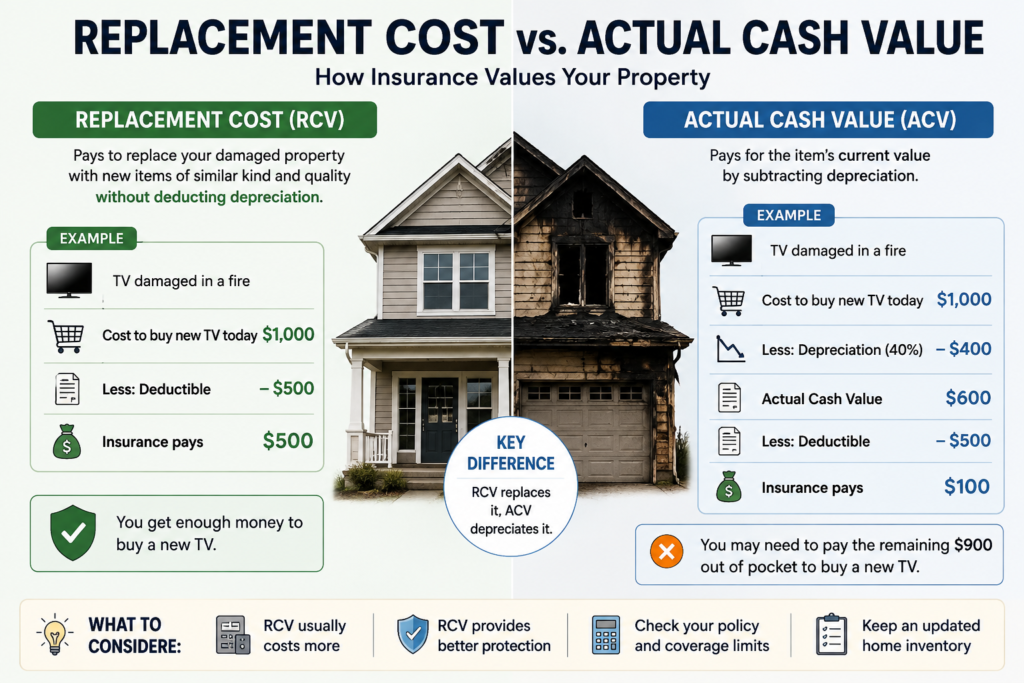
When homeowners or renters purchase insurance, they often focus on coverage limits and premiums. But another important detail can have a major impact on how much money they receive after a covered loss: how the insurance company values damaged or destroyed property.
What you’ll understand
- Home Contents Quick Estimator
- What Is Replacement Cost?
- What Is Actual Cash Value?
Two common valuation methods are Replacement Cost Value (RCV) and Actual Cash Value (ACV).
The difference can be substantial.
Replacement cost coverage generally considers what it costs to replace damaged property with new property of similar kind and quality, subject to policy terms and limits.
Home Contents Quick Estimator
Add your own rough estimates to see how quickly household contents can add up.
This is a rough inventory aid, not a valuation or coverage recommendation. High-value items can have separate limits and documentation requirements.
Actual cash value generally takes depreciation into account.
That means two people could lose similar belongings in comparable covered events but receive different claim payments depending on the valuation method in their policies.
This guide explains replacement cost versus actual cash value, how depreciation works, how claims may be settled, and what consumers should consider when reviewing homeowners or renters insurance.
What Is Replacement Cost?
Replacement Cost Value (RCV) generally represents the cost of repairing or replacing damaged property with property of similar kind and quality at current prices, without deducting for depreciation.
Suppose a covered fire destroys a television that originally cost $1,200 several years ago.
A comparable television now costs $1,000.
With replacement cost coverage, the claim may ultimately be based on the cost of obtaining a comparable new television, subject to:
- Your deductible
- Coverage limits
- Policy conditions
- Applicable claim-settlement provisions
Replacement cost does not necessarily mean the insurer will purchase the most expensive version available.
The replacement generally needs to be comparable to the damaged property.
What Is Actual Cash Value?
Actual Cash Value (ACV) generally considers depreciation when determining the value of damaged or destroyed property.
A simplified way of understanding it is:
Replacement Cost − Depreciation = Actual Cash Value
However, insurers and state laws may determine actual cash value differently, so this formula should be viewed as an illustration rather than a universal legal definition.
Consider the same television.
A comparable replacement costs:
$1,000
Suppose the insurer determines applicable depreciation is:
$400
The estimated ACV would be:
$1,000 − $400 = $600
The applicable deductible and other policy provisions could further affect the claim payment.
Replacement Cost vs. Actual Cash Value at a Glance
| Replacement Cost | Actual Cash Value |
|---|---|
| Generally does not deduct depreciation | Generally reflects depreciation |
| Designed to help replace property with comparable new property | Reflects the property’s depreciated value |
| Usually provides greater protection | May result in a lower claim settlement |
| Often costs more | May have lower premiums |
| Subject to policy limits and conditions | Subject to policy limits and conditions |
What Is Depreciation?
Depreciation represents the reduction in an item’s value over time.
Several factors may influence depreciation, including:
- Age
- Condition
- Expected useful life
- Wear and tear
- Obsolescence
- Type of property
Different items depreciate at different rates.
Furniture, electronics, clothing, appliances, and building materials may all be treated differently.
Simple Depreciation Example
Suppose a washing machine has:
Current replacement cost: $1,000
Estimated useful life: 10 years
Age at time of loss: 5 years
Under a simplified straight-line depreciation example, approximately 50% of the item’s useful life has passed.
Estimated depreciation:
$500
Estimated ACV:
$1,000 − $500 = $500
This is only an educational example. Insurers may use different depreciation methods depending on the policy, property, condition, and applicable state law.
How Replacement Cost Claims May Be Paid
A common misconception is that replacement cost insurance always means receiving the full replacement amount immediately.
Some policies use a two-stage settlement process.
For example:
Stage 1: Initial ACV Payment
The insurer may initially pay the property’s actual cash value, less the applicable deductible.
Stage 2: Recoverable Depreciation
After you repair or replace the property and submit documentation, the insurer may pay eligible recoverable depreciation.
This additional payment is subject to policy requirements and coverage limits.
Example of Recoverable Depreciation
Suppose covered furniture is destroyed.
Replacement cost: $5,000
Depreciation: $1,500
Actual cash value: $3,500
The insurer may initially settle the covered property at its ACV.
After you replace the furniture and provide the required documentation, the insurer may reimburse some or all of the eligible $1,500 in recoverable depreciation, subject to the policy.
Your deductible and other limits may also apply.
What Is Non-Recoverable Depreciation?
Not all depreciation is necessarily recoverable.
If your policy settles property exclusively on an actual cash value basis, depreciation may not be reimbursed later.
Certain property categories may also be subject to special settlement provisions.
Read the policy carefully to determine:
- Which property receives replacement cost treatment
- Which property receives ACV treatment
- Whether depreciation is recoverable
- What documentation is required
- How long you have to complete repairs or replacements
Replacement Cost Coverage for Your Home
Replacement cost coverage isn’t limited to personal belongings.
Homeowners insurance may also use replacement cost principles when insuring the dwelling itself.
The dwelling coverage limit should generally reflect the estimated cost to rebuild the insured home—not simply the home’s market price.
These are different concepts.
Replacement Cost Is Not Market Value
This distinction is particularly important.
Market value reflects what your home and land might sell for in the real estate market.
Replacement cost estimates what it would cost to rebuild the insured structure using materials and construction of similar kind and quality, subject to policy provisions.
Rebuilding costs can be influenced by:
- Construction labor
- Building materials
- Demolition
- Debris removal
- Building design
- Local construction costs
- Contractor demand
- Applicable building requirements
A home’s replacement cost may therefore be higher or lower than its market value.
Replacement Cost for Personal Property
Personal property coverage can apply to possessions such as:
- Furniture
- Clothing
- Electronics
- Appliances
- Kitchenware
- Sporting equipment
- Books
- Home décor
If these belongings are insured at replacement cost, covered losses may ultimately be settled based on eligible replacement costs rather than their depreciated values.
Actual Cash Value for Personal Property
With ACV coverage, age and depreciation can substantially reduce payments for older possessions.
Consider a sofa purchased seven years ago for $2,000.
A comparable new sofa now costs $2,400.
If the insurer determines the old sofa has significantly depreciated, an ACV settlement could be much less than $2,400.
You may need to pay the difference yourself if you want to purchase a new replacement.
Why Replacement Cost Coverage Usually Costs More
Replacement cost insurance creates the potential for larger claim payments because depreciation generally isn’t deducted from the final eligible replacement cost.
Insurers may therefore charge a higher premium for replacement cost coverage.
The additional cost can vary based on:
- Property value
- Coverage limits
- Location
- Insurer
- Deductible
- Claims history
- Policy structure
Compare the additional premium with the financial protection provided.
Replacement Cost vs. ACV Example
Imagine a covered kitchen fire damages several appliances.
| Item | Replacement Cost | Depreciation | Estimated ACV |
| Refrigerator | $2,000 | $800 | $1,200 |
| Dishwasher | $900 | $300 | $600 |
| Microwave | $400 | $200 | $200 |
| Range | $1,500 | $500 | $1,000 |
| Total | $4,800 | $1,800 | $3,000 |
In this simplified example, there is an $1,800 difference between replacement cost and actual cash value before considering the deductible or other policy provisions.
Across an entire household, depreciation can create a much larger difference.
Replacement Cost in Renters Insurance
Renters should also pay attention to valuation methods.
A renters policy protects qualifying personal belongings rather than the landlord’s building.
If your belongings are insured using ACV, depreciation may significantly reduce your settlement after a major covered loss.
Replacement cost personal property coverage may cost more but can provide substantially greater reimbursement when replacing older possessions.
Extended Replacement Cost Coverage
Some homeowners policies offer extended replacement cost coverage.
This feature may provide additional dwelling coverage above the stated dwelling limit when rebuilding costs exceed expectations after a covered loss.
For example, a policy might provide a specified percentage above the dwelling limit.
Exact percentages and conditions vary by insurer.
This protection can be particularly useful when widespread disasters cause construction costs to rise quickly.
Guaranteed Replacement Cost
Some insurers may offer guaranteed replacement cost coverage.
Subject to policy conditions, it may cover qualifying rebuilding costs even when they exceed the stated dwelling limit.
Availability varies significantly by:
- Insurer
- State
- Property
- Underwriting requirements
Guaranteed replacement cost should not be confused with ordinary replacement cost coverage.
Replacement Cost and Inflation
Construction and replacement costs change over time.
Inflation can increase the cost of:
- Lumber
- Roofing materials
- Appliances
- Furniture
- Contractor labor
- Electrical equipment
- Plumbing materials
Some policies include inflation-guard provisions that periodically adjust coverage limits.
Even with these provisions, homeowners should review dwelling limits regularly.
Special Limits for Valuable Property
Replacement cost coverage does not necessarily mean every possession is covered without limitation.
Homeowners and renters policies may impose special limits on categories such as:
- Jewelry
- Watches
- Fine art
- Collectibles
- Certain electronics
- Silverware
- Firearms
- Money
- Business property
High-value possessions may require scheduled personal property coverage or another endorsement.
Why a Home Inventory Matters
A detailed home inventory can make property claims easier to document.
Record information such as:
- Item description
- Brand
- Model
- Serial number
- Purchase date
- Approximate purchase price
- Photographs
- Videos
- Receipts
Store your inventory somewhere secure and accessible outside your home or in protected cloud storage.
How to Determine Your Current Coverage
Check your policy declarations and personal property provisions.
Look for terminology such as:
- Replacement Cost
- Replacement Cost Value
- RCV
- Actual Cash Value
- ACV
- Replacement Cost Contents
- Personal Property Replacement Cost
If you’re uncertain, ask your insurer or agent directly:
“Are my dwelling and personal belongings settled at replacement cost or actual cash value?”
The answer can have a significant effect on future claims.
Which Is Better: Replacement Cost or Actual Cash Value?
Neither option is automatically right for every consumer.
Replacement cost generally provides stronger financial protection because depreciation isn’t deducted from the final eligible replacement amount.
However, it may have a higher premium.
ACV coverage may reduce premiums but exposes the policyholder to a larger potential financial gap after a loss.
The decision should consider:
- Value of your belongings
- Age of your belongings
- Emergency savings
- Premium difference
- Ability to replace property yourself
- Personal risk tolerance
When Replacement Cost May Be Worth Considering
Replacement cost coverage may be particularly valuable when:
- You own significant household belongings.
- Replacing your possessions yourself would be difficult.
- Your home contains expensive furniture or electronics.
- You want stronger protection after a major loss.
- You prefer less exposure to depreciation.
When ACV Coverage Might Be Considered
Some consumers may choose ACV when:
- Lower premiums are a major priority.
- They have substantial savings.
- Their belongings have relatively low replacement value.
- They are comfortable accepting more financial risk.
Before choosing ACV solely to reduce premiums, estimate how much it would actually cost to replace your household possessions after a major loss.
Common Mistakes to Avoid
Assuming Replacement Cost Means Unlimited Coverage
Replacement cost claims remain subject to policy limits, exclusions, and conditions.
Confusing Replacement Cost With Market Value
Rebuilding a house and purchasing a similar house in the real estate market are different calculations.
Ignoring Depreciation
ACV claim payments can be substantially lower than the cost of buying new replacements.
Throwing Away Damaged Property Too Soon
Unless safety requires immediate disposal, document damaged property and follow your insurer’s instructions before discarding it.
Failing to Keep Receipts
Receipts and replacement documentation may be important when claiming recoverable depreciation.
Ignoring Special Property Limits
Expensive jewelry, art, collectibles, and similar possessions may require additional coverage.
Frequently Asked Questions
What is the main difference between replacement cost and actual cash value?
Replacement cost generally covers the cost of replacing eligible damaged property with comparable new property without deducting depreciation. Actual cash value generally reflects depreciation.
Does replacement cost insurance pay everything immediately?
Not necessarily. Some policies initially pay ACV and reimburse eligible recoverable depreciation after repair or replacement requirements are satisfied.
What is recoverable depreciation?
Recoverable depreciation is the portion of depreciation that may be reimbursed under a replacement cost policy after the policyholder repairs or replaces covered property and meets applicable requirements.
Is replacement cost the same as the amount I paid for an item?
No. Replacement cost generally considers the current cost of a comparable replacement rather than the item’s original purchase price.
Is home replacement cost the same as market value?
No. Market value relates to the property’s real estate value, while replacement cost focuses primarily on rebuilding the insured structure.
Does renters insurance offer replacement cost coverage?
Many insurers offer replacement cost options for renters insurance personal property, although availability and terms vary.
Does replacement cost coverage have a deductible?
Usually, yes. The policy’s applicable deductible generally still applies to a covered claim.
Are valuable items fully covered at replacement cost?
Not necessarily. Certain categories may have special limits and may require additional scheduled coverage.
Final Thoughts
The difference between Replacement Cost Value and Actual Cash Value may look technical when you’re purchasing insurance, but it can become extremely important after a major claim.
Replacement cost coverage generally provides stronger protection by helping pay the current cost of replacing eligible damaged property without ultimately deducting depreciation, subject to policy requirements.
Actual cash value generally reflects depreciation, which can leave a significant gap between an insurance settlement and the amount required to purchase new replacements.
Neither option should be evaluated based solely on premium.
Consider the value and age of your possessions, your emergency savings, the cost difference between coverage options, applicable limits, and how much financial risk you could comfortably absorb after a major loss.
Most importantly, review your policy before you need to make a claim. Knowing whether your home and belongings are insured at replacement cost or actual cash value can prevent an unwelcome surprise after a fire, theft, storm, or other covered event.
Key terms in this guide
Tap a term to review the plain-English meaning while you read.
Premium
The amount charged for insurance coverage, usually paid monthly, quarterly or annually.
Deductible
The amount you may need to pay toward a covered loss before the insurer pays under the policy, subject to the policy terms.
Policy Limit
The maximum amount an insurer may pay for a covered loss or category of loss under the policy.
Exclusion
A policy provision that removes specified situations, causes, property, people or losses from coverage.
Endorsement
A document that changes, adds to or removes terms from the standard insurance policy.
Underwriting
The process an insurer uses to evaluate risk and decide whether and on what terms to offer coverage.
Did the guide make sense?
Answer two quick questions. Your score stays in this browser.
Verify Current Rules
Insurance rules, benefits and product terms can change. These official resources are useful starting points for checking current requirements; they do not replace your policy documents or jurisdiction-specific advice.
Thanks — your response is saved in this browser.
Continue learning, not just scrolling
Follow a practical path from understanding the idea to comparing options and preparing for real-world decisions.
 StartWorkers’ Compensation Insurance Guide: Coverage, Benefits, Costs, and Employer ResponsibilitiesBuild the foundation →
 CompareBehavioral Health Riders in Disability Insurance: Limits, Definitions, and What to CompareCompare your options →
 PlanMedicare Advantage 2026: A Plan-Comparison Checklist for Networks, Drugs, and CostsUnderstand the numbers →
 ActInvisible and Autoimmune Disability Claims: Building Evidence Around FunctionBe ready for a claim →
Leave a Comment
Share a helpful question or experience. Your email address will not be published.