

AI makes that exposure more complicated.
A client may claim:
“You promised this AI system would work—and it didn’t.”
That allegation can potentially turn a disappointing technology project into a costly professional-liability dispute.
What Does “Failure to Perform” Mean?
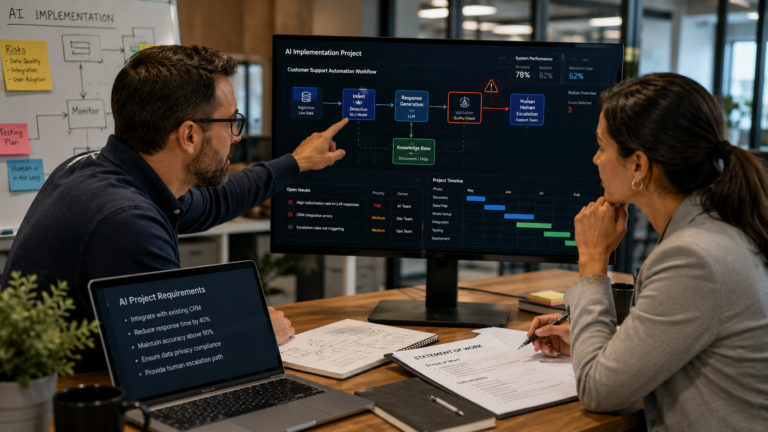
Imagine you’re hired to implement an AI customer-service system for an online retailer.
The contract says the system should:
- Integrate with the client’s CRM
- Categorize customer inquiries
- Generate suggested responses
- Route difficult cases to humans
- Reduce response times
- Operate within agreed technical requirements
Six months later, the client says the implementation failed.
The AI:
misclassifies requests
produces inaccurate responses
fails to escalate important cases
and
doesn’t integrate correctly with the CRM.
The client alleges that your company failed to deliver the professional services it was hired to provide.
It demands:
$600,000 in damages.
This is the type of dispute where technology E&O coverage may become relevant—depending on exactly what happened and how the policy is written.
What Is Technology E&O Insurance?
Technology E&O is a form of professional liability coverage designed for businesses providing technology-related professional services or products.
Depending on the policy, it may address claims alleging:
- Professional negligence
- Errors
- Omissions
- Inaccurate advice
- Failure to deliver contracted services
- Technology-service failures
- Software-related mistakes
The Insurance Information Institute explains that professional liability coverage can protect professionals against financial losses arising from client lawsuits alleging failures in professional services.
For an AI consultant, that can be highly relevant.
General Liability Isn’t the Same Thing
Suppose you’re an IT consultant visiting a client’s office.
You accidentally knock over an expensive monitor.
That sounds more like a traditional:
property-damage liability claim.
Now consider something very different.
You configure an AI workflow incorrectly.
The client’s automated system sends inaccurate information to thousands of customers.
The client loses money and sues you for professional negligence.
That’s a:
professional-services exposure.
Commercial general liability and professional liability serve different purposes. Triple-I specifically notes that professional liability/E&O is designed for claims involving professional mistakes, negligence or failure to perform as promised.
Why AI Creates New E&O Questions
Traditional software is already complicated.
AI introduces additional uncertainty.
An AI implementation can involve:
Client data
Third-party models
APIs
Prompts
Retrieval systems
Automated workflows
Human decisions
Cloud infrastructure
A failure anywhere in that chain can potentially affect the final result.
And when something goes wrong, the client may simply say:
“You built it.”
Scenario 1: AI Hallucinations Cause Financial Loss
Suppose a consulting company implements a generative-AI assistant for a financial-services client.
The system is supposed to help employees find internal information.
Instead, it occasionally generates inaccurate answers.
An employee relies on one.
The client suffers a significant financial loss.
Now everyone starts asking:
Was the model defective?
Was the consultant negligent?
Was the prompt architecture inadequate?
Was the client’s data wrong?
Should human review have been required?
Did the client use the system outside its intended purpose?
That complexity is exactly why AI contracts and E&O coverage deserve careful attention.
NIST’s Generative AI Profile recognizes that generative AI introduces or intensifies specific risks and recommends managing those risks throughout the AI lifecycle.
Scenario 2: The Integration Doesn’t Work
A retailer hires you for:
$150,000
to integrate an AI inventory-forecasting system.
You complete the project.
But the system repeatedly produces poor forecasts because the integration uses incomplete inventory data.
The client claims it suffered:
$750,000 in lost sales and excess inventory costs.
The dispute becomes:
Who was responsible for validating the data?
Your company?
The client?
The software vendor?
This is why your contract and your E&O policy must work together.
Scenario 3: AI Automation Takes the Wrong Action
Now imagine an AI system isn’t merely generating information.
It can take actions.
An automated agent can:
issue refunds
change orders
approve transactions
send communications
update customer records.
A configuration mistake causes the system to issue thousands of incorrect refunds.
The client claims:
$400,000 in losses.
The key question isn’t merely:
“Did the AI make a mistake?”
It becomes:
“Did the consultant negligently design, test or deploy the system?”
AI Agents Increase the Stakes
Generative AI is moving beyond:
Question → Answer
toward:
Goal → Decision → Action.
That changes the risk profile.
A chatbot giving an inaccurate answer may create one type of loss.
An AI agent capable of taking autonomous actions can potentially create a much larger chain of consequences.
NIST’s AI Risk Management Framework emphasizes that AI risks should be addressed throughout design, development, deployment, evaluation and use. Its framework organizes AI risk management around four functions:
Govern → Map → Measure → Manage.
For consultants, documenting those processes can become increasingly valuable.
Your Client May Blame You Even When the Vendor Failed
Imagine you implement a third-party AI model.
The model provider experiences a technical problem.
Your client’s application stops working.
The client loses revenue.
The consultant says:
“That wasn’t our system—it was the AI vendor.”
The client replies:
“You recommended the vendor.”
Now the dispute may involve:
vendor selection + professional advice + integration + contractual responsibility.
That’s why consultants should review whether their E&O policy addresses claims arising from services involving third-party technology.
Don’t Assume “AI” Is Automatically Covered
This is critical in 2026.
You may have purchased technology E&O five years ago.
At the time, your company provided:
website development + software consulting + cloud integration.
Today you’re providing:
LLM implementation + AI agents + automated decision systems + custom model integrations.
Your business has changed.
Has your insurance?
Ask your broker or insurer whether your policy’s description of professional services accurately includes your current AI activities.
The Professional Services Definition Matters
Find this section in your policy:
Professional Services
or equivalent wording.
Suppose it describes your company as:
“Information technology consulting services.”
Does that encompass:
AI model implementation?
Generative AI consulting?
AI agent development?
Prompt engineering?
Machine-learning integration?
AI governance consulting?
Don’t assume.
Ask.
If necessary, request that your insurance professional confirm how your current services are treated.
Your Insurance Application Matters Too
Suppose your application says:
80% website development
20% IT consulting
but your actual business has become:
70% AI implementation
30% software consulting.
That discrepancy could matter.
Keep your insurer informed when your business materially changes.
Your coverage should reflect what you actually do—not what you did three years ago.
Contractual Liability Can Create a Gap
Imagine your contract promises:
“The AI system will achieve 99.99% accuracy.”
That’s a dangerous promise.
Why?
Because you may have voluntarily accepted a contractual obligation far beyond what your insurance policy covers.
An E&O policy does not necessarily guarantee every contractual promise you make.
Review provisions concerning:
contractual liability
and contractual assumptions of liability.
Your lawyer and insurance broker should review significant technology contracts together where appropriate.
Be Careful With Performance Guarantees
AI consultants should be particularly cautious about promises such as:
“100% accurate.”
“Zero hallucinations.”
“Guaranteed 50% productivity improvement.”
“Completely unbiased.”
“Fully autonomous and error-free.”
These statements can create unrealistic client expectations.
AI systems inherently involve uncertainty.
NIST’s AI RMF specifically emphasizes understanding the limitations and uncertainties associated with AI systems.
Use measurable and realistic project specifications instead.
Define What “Success” Means
Instead of:
“Implement a successful AI assistant.”
define:
Supported use cases
Data sources
Testing criteria
Accuracy methodology
Escalation procedures
Human-review requirements
Deployment milestones
Excluded use cases
Client responsibilities
Acceptance testing
Now both parties have a clearer understanding of what:
“performed successfully”
actually means.
Human Oversight Can Reduce Risk
Consider an AI system generating customer refunds.
Option A:
AI decides → refund automatically issued.
Option B:
AI recommends → employee reviews → refund issued.
Option B introduces another control.
Not every AI workflow requires human approval, but high-impact actions deserve careful consideration.
NIST’s framework encourages organizations to identify, evaluate and manage AI risks throughout the system lifecycle.
Testing Is Your Best Defense
Before deployment, document:
What did we test?
What data did we use?
What failed?
What was corrected?
What limitations remain?
What did the client approve?
This documentation can be valuable if a dispute arises later.
Imagine a client claims:
“You never told us the model could generate inaccurate answers.”
You produce:
Testing report
Risk assessment
Written limitation disclosure
Client acceptance
Training records.
That doesn’t guarantee you’ll avoid liability.
But it creates a much stronger factual record.
Create an AI Acceptance Test
Before production deployment, consider agreeing with the client on measurable acceptance criteria.
For example:
CRM integration: Passed
Required data retrieval: Passed
Response latency: Within agreed range
Escalation workflow: Passed
Security testing: Completed
Human-review process: Implemented
Known limitations: Documented
Client approval: Received
The exact test should match the project.
Document Client Responsibilities
AI implementations are rarely consultant-only projects.
Clients may need to provide:
- Accurate data
- System access
- Subject-matter experts
- Security requirements
- Legal requirements
- User testing
- Final approval
- Human oversight
- Employee training
If the client provides inaccurate data and the system produces inaccurate results, responsibility can become disputed.
Your contract should clearly identify:
who is responsible for what.
Data Quality Can Become an E&O Problem
AI performance often depends heavily on data.
Think:
Poor data → poor output.
Suppose your client provides outdated product information.
The AI uses it.
Customers receive inaccurate product recommendations.
Who is responsible?
The answer may depend on:
contract + implementation + testing + representations + policy wording + applicable law.
NIST emphasizes data and system evaluation as important parts of managing AI risk.
Cyber Insurance and E&O Can Overlap
AI implementation can create both:
professional liability risk
and
cyber risk.
Suppose your AI integration accidentally exposes customer data.
The client alleges:
Professional negligence
while affected customers raise:
privacy claims.
Which policy responds?
Potentially:
Technology E&O
Cyber liability
or a combined:
Tech E&O + Cyber policy.
Coverage depends on the actual policies.
Consultants should understand how the two policies interact.
Intellectual Property Is Another AI Risk
Generative AI can create questions involving:
- Copyright
- Training data
- Generated content
- Software code
- Trademarks
- Confidential information
A client might claim that your implementation produced content creating an intellectual-property dispute.
Does your E&O policy cover that?
Maybe.
Maybe not.
Check:
IP exclusions + media liability + technology coverage + AI-related endorsements.
Do not assume professional liability automatically covers every intellectual-property claim.
What About Confidential Client Data?
Suppose an employee enters confidential client information into an unauthorized public AI service.
That information becomes exposed.
This isn’t purely:
an E&O issue.
It may involve:
cyber liability + privacy + contractual liability + professional negligence.
Tech consultants working with AI should therefore consider their entire insurance program rather than buying E&O in isolation.
Most E&O Policies Are Claims-Made
This is extremely important.
Triple-I explains that most professional liability policies are written on a claims-made basis.
That means timing matters.
Depending on the policy, you may need coverage in effect when:
the claim is made
and potentially need the relevant wrongful act to occur after the applicable:
retroactive date.
Never cancel an E&O policy casually after finishing an AI project.
A client could complain:
months or years later.
Understand the Retroactive Date
Suppose:
AI project completed: 2025
Client discovers alleged error: 2027
Lawsuit filed: 2027
Whether your 2027 policy responds can depend partly on its claims-made terms and retroactive date.
If you switch insurers, protect:
prior acts coverage
where appropriate.
A gap can be expensive.
Defense Costs Matter
Suppose a client demands:
$800,000.
You believe you did nothing wrong.
You still need attorneys.
Professional-liability insurance can cover legal defense against qualifying claims, subject to policy terms and limits.
But ask:
Are defense costs inside or outside the limit?
If they’re inside:
$1 million limit
minus
$300,000 defense costs
could leave substantially less available for a settlement or judgment.
How Much E&O Coverage Does an AI Consultant Need?
There is no universal answer.
Consider:
Contract value
Maximum foreseeable client loss
Size of clients
Services provided
Degree of automation
Data sensitivity
Contractual requirements
Defense costs
Number of projects
A consultant charging:
$25,000 per project
to small businesses may have very different exposure from a consultancy implementing:
$5 million AI systems
for financial institutions.
$1 Million May Not Always Be Enough
Imagine:
E&O limit: $1 million
A failed AI implementation generates:
Legal defense — $250,000
Client settlement — $850,000
Potential total:
$1.1 million.
If defense costs erode the same limit, the available insurance may be insufficient.
This is only an illustration, but it shows why limits should reflect your actual projects.
Review Your Largest Client
One useful exercise is:
What happens if our largest client alleges our biggest AI project failed completely?
Estimate:
- Potential remediation cost
- Client lost revenue
- Replacement-system expense
- Legal defense
- Contractual damages
- Third-party claims
Then compare the scenario with your:
E&O limit + deductible/retention + sublimits + exclusions.
Don’t Forget Your Deductible or Retention
A policy might provide:
$2 million E&O limit
with:
$25,000 retention.
Your company needs to be capable of funding that retention during a dispute.
A high limit with an unaffordable retention can still create a cash-flow problem.
Red Flags in AI Consulting Contracts
Before signing a major AI implementation agreement, pay particular attention to:
- Unlimited liability
- Broad indemnification
- Guaranteed performance
- Guaranteed accuracy
- Guaranteed regulatory compliance
- Broad intellectual-property warranties
- Responsibility for third-party platforms
- Consequential damages
- Liquidated damages
- Aggressive service-level guarantees
These aren’t automatically unacceptable.
But they should be reviewed against:
your actual ability to perform + your insurance coverage.
Your Contract and Insurance Should Match
Suppose your contract requires:
$5 million professional liability coverage.
Your policy provides:
$1 million.
Problem.
Or your contract accepts:
unlimited consequential damages
while your insurance excludes or limits some contractual exposures.
Another problem.
Your contract should not casually create liabilities far beyond your insurance program.
AI Risk Management Can Help Your Insurability
Good AI governance isn’t just for large corporations.
A consultant should be able to show:
Risk assessment
Testing
Human oversight
Change control
Data governance
Incident response
Client acceptance
Monitoring
NIST’s AI RMF provides a useful voluntary structure organized around Govern, Map, Measure and Manage.
This can help transform:
“We think our AI implementation is safe.”
into:
“Here is how we manage and document the risk.”
What to Ask Your E&O Insurer in 2026
Before renewing your coverage, ask:
- Does my professional-services definition include AI consulting?
- Are generative AI implementations covered?
- Are AI-agent projects covered?
- Does coverage include software development?
- Does it include systems integration?
- Are claims involving third-party AI platforms covered?
- Are failure-to-perform allegations covered?
- Are contractual liability claims restricted?
- Are intellectual-property claims covered or excluded?
- Does the policy include cyber liability?
- Are privacy claims covered?
- Are defense costs inside the limit?
- What deductible or retention applies?
- What is my retroactive date?
- Is prior-acts coverage included?
- What happens if I switch insurers?
- Are regulatory investigations covered?
- Are there AI-specific exclusions or endorsements?
- Do subcontractors qualify under the policy?
- Does the insurer need to approve major changes in our services?
AI Consultant Risk Checklist
Before deploying an AI system:
- Define the project’s scope.
- Define measurable acceptance criteria.
- Document AI limitations.
- Avoid unrealistic performance guarantees.
- Define client responsibilities.
- Review data quality.
- Test integrations.
- Test failure scenarios.
- Establish human oversight where appropriate.
- Document third-party AI dependencies.
- Review cybersecurity.
- Review privacy requirements.
- Document client approval.
- Maintain change-control records.
- Monitor production performance.
- Maintain incident-response procedures.
- Review contracts with counsel where appropriate.
- Confirm E&O covers your actual services.
- Review cyber coverage.
- Maintain continuous claims-made coverage where needed.
Frequently Asked Questions
What is E&O insurance for tech consultants?
Errors & Omissions insurance is professional liability coverage that can protect technology consultants against qualifying claims alleging professional errors, negligence, misrepresentation or inaccurate advice. IT consultants and software developers are among the professionals Triple-I identifies as candidates for professional liability insurance.
Can E&O cover a failed AI implementation?
Potentially. If a client alleges that your professional services were negligent or failed to meet applicable obligations, technology E&O may respond. However, coverage depends on the claim, policy wording, exclusions and endorsements.
Does general liability cover software mistakes?
General liability and professional liability address different exposures. Professional E&O is generally the more relevant coverage when a client alleges financial loss caused by mistakes in professional technology services.
Is AI automatically included in technology E&O?
Don’t assume so. Review your professional-services definition and any AI, technology, cyber, data or intellectual-property exclusions and endorsements.
What if the AI vendor caused the failure?
The client could still allege that you negligently selected, configured, integrated or recommended the vendor. Whether your policy responds depends on the allegations and coverage terms.
Does E&O cover AI hallucinations?
Potentially, if the hallucination leads to a covered professional-liability claim against your company. But AI-specific exclusions, contractual obligations and the circumstances of the loss can affect coverage.
Do I need cyber insurance as well?
Often it is worth considering. E&O generally focuses on professional-service failures, while cyber insurance can address data breaches, privacy events, ransomware and related cyber exposures. Some technology policies combine both.
Why does the retroactive date matter?
Most professional-liability policies are claims-made, so the timing of the alleged wrongful act and claim can be critical.
Can I guarantee my AI system will be accurate?
Be very cautious about absolute guarantees. AI systems can have limitations and uncertainty, and NIST recommends identifying and managing AI risks throughout their lifecycle.
Is the NIST AI Risk Management Framework mandatory?
The NIST AI RMF is a voluntary framework intended to help organizations manage AI risks and improve trustworthy AI development and use.
Final Thoughts
For technology consultants, AI changes the scale and complexity of professional liability.
A traditional software mistake might cause:
a broken feature.
An AI implementation mistake could potentially cause:
incorrect outputs → automated decisions → customer impact → lost revenue → client claim.
That doesn’t mean every failed AI project creates an insured E&O claim.
It means consultants should think carefully about the connection between:
AI project scope + contracts + testing + documentation + risk management + insurance.
The strongest defense isn’t simply:
“We have a $1 million E&O policy.”
It is:
Clear scope → realistic promises → documented testing → human oversight where appropriate → client acceptance → suitable E&O and cyber coverage.
As AI projects become more autonomous, consultants should make sure their insurance evolves alongside the services they provide.