
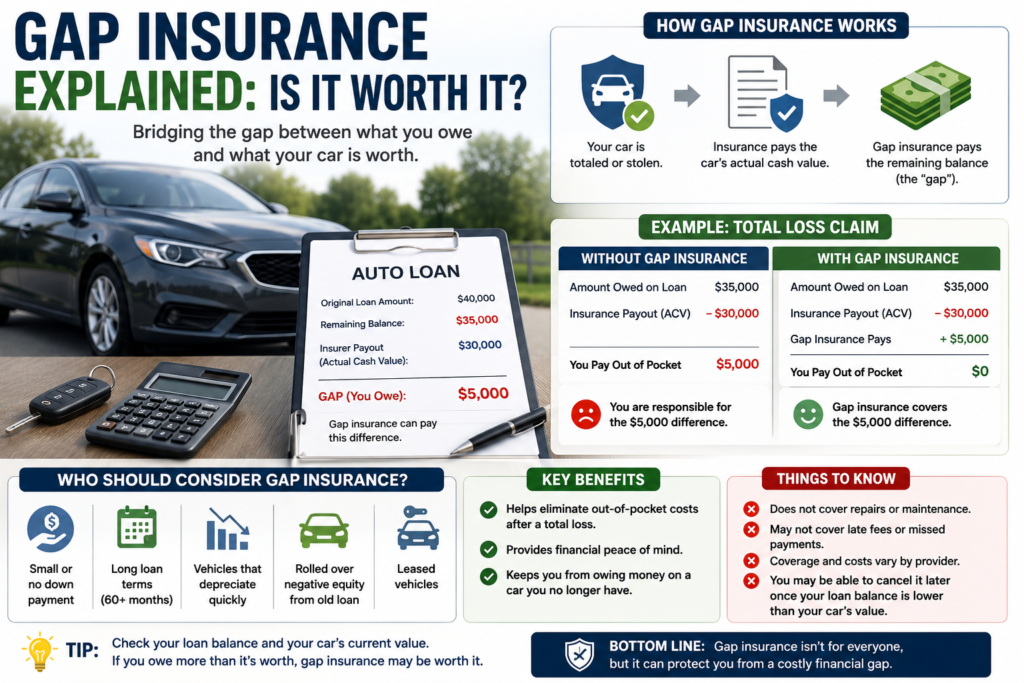
Imagine buying a new vehicle for $40,000. A year later, the car is stolen or severely damaged and declared a total loss.
What you’ll understand
- Auto Coverage Scenario Checker
- What Is Gap Insurance?
- How Does Gap Insurance Work?
You still owe $35,000 on the auto loan, but your insurance company determines that the vehicle’s covered value immediately before the loss was only $30,000.
That potentially leaves a $5,000 difference between what you owe and the vehicle’s value.
This is the type of situation where gap insurance may help.
Auto Coverage Scenario Checker
Choose an incident to see which part of an auto policy is commonly worth reviewing.
This tool identifies common coverage areas to review. It does not determine whether a claim is covered; policy wording, deductibles, limits, exclusions and local law control.
Gap insurance—sometimes called guaranteed asset protection—is designed to help with certain differences between the amount owed on a financed or leased vehicle and the amount paid by primary auto insurance after a covered total loss, subject to the gap contract’s terms, limits, exclusions, and deductible treatment.
It can be valuable for some drivers, particularly during the early years of a vehicle loan. But not everyone needs it.
This guide explains how gap insurance works, what it may and may not cover, who should consider it, and how to determine when the coverage may no longer be necessary.
What Is Gap Insurance?
Gap insurance is financial protection designed primarily for drivers who finance or lease vehicles.
Its purpose is to address a potential problem created by vehicle depreciation.
Cars can lose value over time, while loan balances may decline more slowly.
This can create a period when you owe more on the vehicle than it is worth.
This situation is commonly known as:
- Being upside down on a car loan
- Having negative equity
If the vehicle is totaled or stolen during this period, standard comprehensive or collision insurance generally pays according to the vehicle’s covered value rather than automatically paying the entire remaining loan balance.
Gap coverage may help address an eligible shortfall.
How Does Gap Insurance Work?
Consider this simplified example:
Outstanding auto loan: $32,000
Vehicle’s covered value: $27,000
Potential difference: $5,000
If the vehicle is declared a covered total loss, your primary insurer generally determines the settlement according to the auto policy.
If an eligible $5,000 shortfall remains between the applicable insurance settlement and qualifying loan balance, gap coverage may pay some or all of that amount, depending on the contract.
Gap coverage does not simply provide an extra $5,000 to the policyholder to spend.
Its purpose is generally to address an eligible financial obligation connected to the totaled or stolen vehicle.
Why Can a Gap Develop?
The main reason is depreciation.
A vehicle’s market value can decline faster than the amount owed on the loan.
Several factors can increase the likelihood of negative equity:
- Small down payment
- No down payment
- Long loan term
- High financing costs
- Rapid vehicle depreciation
- Rolling an old loan balance into a new loan
- Financing additional products or fees
- High mileage
- Vehicle market changes
The larger the difference between the loan balance and vehicle value, the greater the potential financial exposure after a total loss.
Gap Insurance Example
Suppose you purchase a vehicle for:
$45,000
After some time, you still owe:
$38,000
The vehicle is then stolen and isn’t recovered.
Your insurer determines the covered vehicle value is:
$33,000
For simplicity, assume the applicable primary insurance settlement leaves an eligible shortfall of:
$5,000
Without gap protection, you could potentially remain responsible for that amount.
If the shortfall qualifies under your gap contract, gap coverage may help pay it.
Actual settlements depend on deductibles, loan terms, policy limits, exclusions, and the gap agreement.
Does Regular Car Insurance Pay Off Your Loan?
Not necessarily.
Comprehensive and collision insurance generally protect the vehicle, not the exact amount of your financing obligation.
When a covered vehicle is totaled, the insurer typically calculates its value immediately before the loss according to the policy and applicable state rules.
Your lender, however, cares about the amount remaining on the loan.
Those two numbers can be different.
What Does Gap Insurance Typically Cover?
Depending on the contract, gap coverage may help when:
- Your vehicle is declared a covered total loss after a collision.
- Your vehicle is stolen and isn’t recovered.
- A covered comprehensive loss results in a total loss.
- The applicable insurance settlement is less than the qualifying outstanding loan or lease balance.
Exact coverage varies significantly between products.
What Doesn’t Gap Insurance Cover?
Gap insurance isn’t general-purpose vehicle insurance.
It generally does not cover:
- Ordinary vehicle repairs
- Mechanical breakdowns
- Routine maintenance
- Engine failure unrelated to a covered loss
- Injuries
- Medical expenses
- Property damage you cause to another person
- Missed car payments
- Late fees
- Extended warranties
- A voluntary vehicle sale
- Trade-in losses
- Vehicle depreciation by itself
Certain amounts included in a loan may also be excluded from a gap calculation.
Always read the actual contract.
Does Gap Insurance Cover Your Deductible?
It depends.
Some gap products may cover or reduce the impact of an auto insurance deductible up to a specified amount.
Others may not.
For example, suppose:
Vehicle value: $25,000
Collision deductible: $1,000
Your primary insurer’s payment could be reduced by the deductible.
Whether gap protection addresses that $1,000 depends on the specific agreement.
Never assume your deductible is automatically covered.
Gap Insurance vs. Comprehensive Insurance
These are different coverages.
Comprehensive insurance generally protects against covered non-collision events such as:
- Theft
- Fire
- Hail
- Flooding
- Vandalism
- Falling objects
Gap insurance deals with an eligible difference between the vehicle insurance settlement and the qualifying amount owed on financing or a lease.
A theft claim, for example, may involve both comprehensive and gap coverage.
Gap Insurance vs. Collision Insurance
Collision coverage generally helps pay for covered damage to your own vehicle after a collision, subject to the policy.
Gap coverage does not repair collision damage.
Instead, it may become relevant when a covered collision results in the vehicle being declared a total loss and the qualifying loan or lease balance exceeds the applicable vehicle settlement.
Who Should Consider Gap Insurance?
Gap insurance may be worth considering if you:
- Made a small down payment
- Made no down payment
- Have a long-term auto loan
- Financed a vehicle that depreciates quickly
- Rolled negative equity from an older vehicle into the new financing
- Lease your vehicle
- Owe substantially more than the vehicle’s current value
- Would struggle financially to pay a loan shortfall after a total loss
When Gap Insurance May Be Less Necessary
Gap coverage may provide little value when:
- You paid cash for the vehicle.
- You made a large down payment.
- Your loan balance is below the vehicle’s current value.
- You have substantial positive equity.
- Your financing balance has declined significantly.
- You could comfortably absorb any remaining shortfall yourself.
If you don’t have a loan or lease, there generally isn’t a financing “gap” for the coverage to address.
Gap Insurance for Leased Vehicles
Gap protection can be particularly relevant for leased vehicles because drivers don’t own the vehicle outright and may face contractual obligations after a total loss.
However, many lease agreements already include some form of gap protection.
Before purchasing additional coverage, check your lease agreement.
Paying for duplicate protection may be unnecessary.
Gap Insurance for New Cars
New-car buyers frequently consider gap insurance because depreciation can be greatest during the earlier years of ownership.
A buyer making a minimal down payment may become upside down relatively quickly.
That doesn’t mean every new-car owner needs gap coverage.
Compare:
Current loan payoff amount
with
Approximate current vehicle value
The greater the negative equity, the stronger the potential case for gap protection.
Do Used Cars Need Gap Insurance?
Potentially.
Gap coverage isn’t exclusively for new cars.
A used vehicle can also have negative equity if:
- The down payment was small.
- The loan term is long.
- The purchase price was high relative to market value.
- Previous negative equity was included in financing.
- Additional products were financed.
Eligibility for gap coverage on used vehicles varies by provider.
What About Rolled-Over Negative Equity?
Suppose you trade in a vehicle while still owing more than it is worth.
You owe:
$20,000
Trade-in value:
$15,000
Negative equity:
$5,000
If that $5,000 is rolled into your next auto loan, you may begin the new loan already owing significantly more than the new vehicle’s value.
This can create a substantial gap.
However, gap contracts may limit or exclude portions of prior negative equity.
Read the contract carefully before assuming the entire rolled-over amount will be covered.
Where Can You Get Gap Coverage?
Gap protection may be available from:
- Auto insurance companies
- Vehicle dealerships
- Lenders
- Credit unions
- Lease providers
The product structure can vary depending on the provider.
Coverage purchased through an auto insurer may operate differently from a gap waiver offered through a dealership or lender.
Compare both price and contract terms rather than assuming every gap product is identical.
How Much Does Gap Insurance Cost?
There is no universal price.
The cost can depend on:
- Provider
- Vehicle
- Financing
- State
- Coverage structure
- How the product is purchased
An auto insurer may offer gap coverage as an endorsement or optional coverage on an existing policy.
A dealership or lender may offer a separate product, potentially for a one-time price.
If the cost is added to your vehicle financing, you may also effectively pay financing charges on that amount.
Compare options before purchasing.
Is Dealer Gap Insurance the Same as Insurer Gap Coverage?
Not necessarily.
Dealer, lender, and insurer products can differ in:
- Eligibility
- Maximum payouts
- Deductible treatment
- Loan-to-value limits
- Exclusions
- Cancellation rules
- Refund provisions
- Treatment of negative equity
Read the contract rather than comparing only the product name.
How to Determine Whether You’re Upside Down
You need two numbers.
1. Your Current Loan Payoff
Ask your lender for the current payoff amount.
This may differ slightly from the balance displayed on your most recent statement.
2. Your Vehicle’s Current Value
Estimate what your vehicle is currently worth using reliable valuation resources and local market information.
Then calculate:
Loan payoff − vehicle value = estimated negative equity
Example:
Loan payoff: $29,000
Estimated vehicle value: $25,000
Estimated negative equity:
$4,000
You may have approximately $4,000 of potential exposure, although an insurer’s actual total-loss valuation could differ from your estimate.
When Should You Drop Gap Insurance?
Gap coverage generally becomes less useful once you owe less than the vehicle is worth.
For example:
Vehicle value: $25,000
Loan payoff: $19,000
You have approximately:
$6,000 of positive equity
In this situation, there may no longer be a meaningful financing gap.
Review your loan balance and vehicle value periodically.
Don’t Keep Paying for Coverage You No Longer Need
Some drivers purchase gap insurance when buying a car and then forget about it.
As your loan balance declines, the coverage can eventually become unnecessary.
Consider reviewing the numbers:
- Every 6–12 months
- After making additional principal payments
- After a major change in used-car values
If you cancel a separately purchased gap product early, check whether you may qualify for a prorated refund under the contract and applicable law.
Gap Insurance and Refinancing
Refinancing can affect gap protection.
Your existing gap agreement may not automatically transfer to a refinanced loan.
Before refinancing, ask:
- Does my current gap coverage terminate?
- Is the new loan eligible for gap coverage?
- Will any refund be available from the old product?
- Does the new lender offer protection?
- What amounts will the new contract exclude?
Don’t assume existing coverage continues automatically.
Gap Insurance and Total-Loss Claims
After a total loss, you may need to coordinate with:
- Your primary auto insurer
- Your lender or lease company
- Your gap provider
Documentation may include:
- Insurance settlement information
- Loan payoff statement
- Financing contract
- Vehicle purchase agreement
- Total-loss documentation
- Payment history
- Gap contract
Keep copies of your vehicle financing and insurance documents while you own the vehicle.
What Happens After Gap Insurance Pays?
If the gap claim covers the qualifying shortfall, the applicable payment generally goes toward satisfying the eligible remaining financing obligation.
Gap coverage typically doesn’t:
- Buy you another vehicle.
- Provide a down payment for your next car.
- Replace the totaled vehicle itself.
You may still need funds to purchase or finance your next vehicle.
Some auto insurance products offer separate new-car replacement or replacement-cost features, which are different from gap insurance.
Gap Insurance vs. New-Car Replacement Coverage
These products solve different problems.
| Gap Insurance | New-Car Replacement |
|---|---|
| Addresses eligible financing shortfall | Helps replace a totaled qualifying vehicle |
| Focuses on loan/lease balance | Focuses on replacement vehicle cost |
| Useful when you have negative equity | Useful when depreciation affects replacement ability |
| Doesn’t normally buy your next car | May provide enhanced replacement settlement |
| Eligibility depends on financing | Usually subject to vehicle age/mileage rules |
Some drivers may qualify for both types of protection.
Is Gap Insurance Worth It?
The answer depends primarily on your negative-equity risk.
Consider gap coverage more seriously when:
Loan balance > vehicle value
especially when the difference is substantial.
Suppose you owe $40,000 on a vehicle worth approximately $32,000.
Potential gap:
$8,000
Paying a relatively modest amount for appropriate gap protection could potentially protect against a meaningful financial loss if the vehicle is totaled.
By contrast, if you owe $15,000 on a vehicle worth $22,000, there may be little reason to maintain gap protection because you have positive equity.
A Quick Gap Insurance Checklist
Before purchasing, ask:
- How much do I currently owe?
- What is my vehicle approximately worth?
- How large is my negative equity?
- Does my lease already include gap protection?
- Does my auto insurer offer gap coverage?
- What does the gap contract cost?
- Is my auto insurance deductible covered?
- Is rolled-over negative equity covered?
- Are financed warranties or add-ons excluded?
- What is the maximum gap benefit?
- Can I cancel the coverage later?
- Could I receive a refund after cancellation?
- What happens if I refinance?
Common Mistakes to Avoid
Assuming Gap Insurance Replaces Your Car
It generally addresses an eligible financing shortfall rather than purchasing a replacement vehicle.
Buying Duplicate Coverage
Your lease or financing agreement may already include gap protection.
Purchasing Without Comparing Prices
Dealer, lender, and insurer options can have significantly different costs and terms.
Ignoring Contract Limits
Gap coverage may not pay every dollar included in your loan.
Keeping Gap Coverage Too Long
Once you have meaningful positive equity, the coverage may no longer provide much benefit.
Assuming Every Total Loss Qualifies
The underlying loss generally needs to meet applicable insurance and gap contract requirements.
Frequently Asked Questions
What is gap insurance?
Gap insurance is protection designed to help address certain differences between an eligible vehicle insurance settlement and the qualifying amount remaining on a loan or lease after a covered total loss.
Do I need gap insurance if I paid cash?
Generally, no. Without a vehicle loan or lease, there is normally no financing gap to protect.
Is gap insurance required?
It is generally not required by state auto insurance laws, but a lender or lease agreement may require gap protection in some circumstances.
Does gap insurance cover theft?
It may apply when a stolen vehicle isn’t recovered and the underlying comprehensive claim results in an eligible total loss, subject to the gap contract.
Does gap insurance cover repairs?
No. It isn’t designed to pay ordinary repair bills.
Does gap insurance cover my deductible?
Some products may address an applicable deductible up to certain limits, while others do not.
Can I cancel gap insurance?
Often, yes, subject to the contract. Depending on how it was purchased and when it is canceled, a refund may sometimes be available.
When should I cancel gap insurance?
Consider whether it is still necessary once your loan payoff is below the vehicle’s value.
Does gap insurance cover negative equity from my previous car?
Not necessarily. Many contracts limit or exclude certain amounts of rolled-over negative equity.
Can I get gap insurance after buying my car?
Potentially. Eligibility and purchase time limits vary by insurer and provider.
Final Thoughts
Gap insurance can be worthwhile, but it isn’t coverage every vehicle owner needs.
Its value is greatest when you owe substantially more on a financed or leased vehicle than the vehicle is currently worth.
Drivers with small down payments, long loan terms, rapidly depreciating vehicles, or significant negative equity may face thousands of dollars in remaining debt after a covered total loss.
Gap protection can help reduce that risk.
However, the coverage becomes less valuable as your loan balance falls below your vehicle’s value.
Before buying, compare your loan payoff amount with your vehicle’s approximate current value. Then compare gap products based on price, exclusions, benefit limits, deductible treatment, and cancellation provisions.
And once you have positive equity, review whether continuing to pay for gap coverage still makes financial sense.
Key terms in this guide
Tap a term to review the plain-English meaning while you read.
Deductible
The amount you may need to pay toward a covered loss before the insurer pays under the policy, subject to the policy terms.
Policy Limit
The maximum amount an insurer may pay for a covered loss or category of loss under the policy.
Exclusion
A policy provision that removes specified situations, causes, property, people or losses from coverage.
Endorsement
A document that changes, adds to or removes terms from the standard insurance policy.
Claim
A request for payment or benefits under an insurance policy after an event that may be covered.
Collision Coverage
Auto coverage that can pay for eligible damage to the insured vehicle from a collision, subject to policy terms and deductible.
Did the guide make sense?
Answer two quick questions. Your score stays in this browser.
Verify Current Rules
Insurance rules, benefits and product terms can change. These official resources are useful starting points for checking current requirements; they do not replace your policy documents or jurisdiction-specific advice.
Thanks — your response is saved in this browser.
Continue learning, not just scrolling
Follow a practical path from understanding the idea to comparing options and preparing for real-world decisions.
 StartWorkers’ Compensation Insurance Guide: Coverage, Benefits, Costs, and Employer ResponsibilitiesBuild the foundation →
 CompareBehavioral Health Riders in Disability Insurance: Limits, Definitions, and What to CompareCompare your options →
 PlanMedicare Advantage 2026: A Plan-Comparison Checklist for Networks, Drugs, and CostsUnderstand the numbers →
 ActInvisible and Autoimmune Disability Claims: Building Evidence Around FunctionBe ready for a claim →
Leave a Comment
Share a helpful question or experience. Your email address will not be published.