
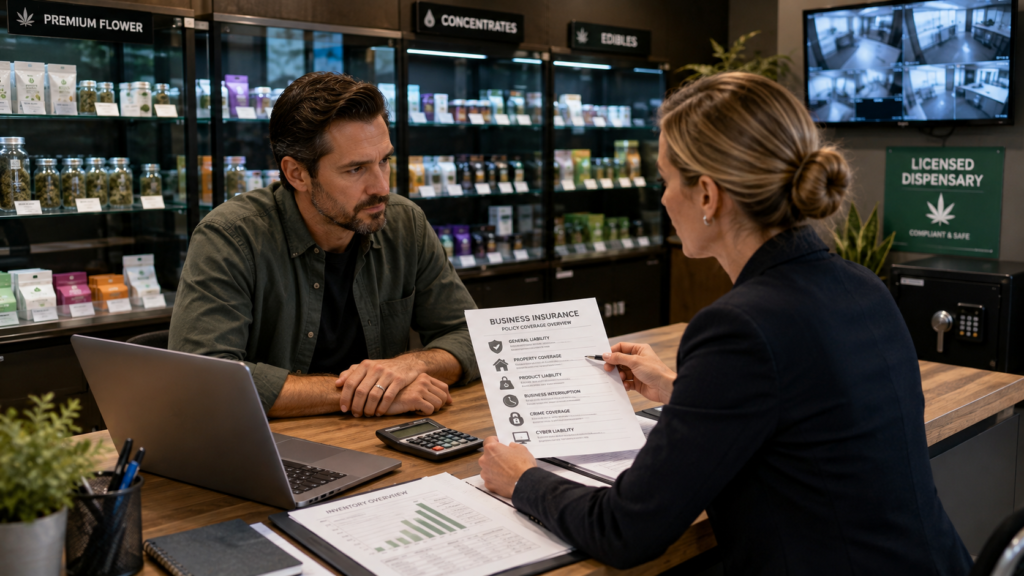
A cannabis business can be properly licensed under state law and still face insurance problems that an ordinary retailer may never encounter. The challenge is not simply finding general liability or property insurance. Cannabis businesses can face unusual underwriting, banking, cash-handling, product, security and regulatory risks, and the details vary by state and by the business activity.
What you’ll understand
- Cannabis Insurance Gap Checker
- Why cannabis business insurance is different
- Core coverage areas to review
For a dispensary, cultivator, manufacturer, distributor, delivery operation or testing laboratory, the practical question is not “Do I have business insurance?” It is “Does my insurance program actually match the activities, property, products and legal environment of this business?”
The National Association of Insurance Commissioners notes that cannabis businesses have historically faced difficulty obtaining comprehensive and affordable insurance and that coverage can involve non-admitted insurance markets. Business owners should therefore pay close attention to who is underwriting each coverage, what the policy says, and which exclusions or sublimits apply.
Cannabis Insurance Gap Checker
Answer a few questions to identify coverage areas worth discussing with a licensed insurance professional.
Educational checklist only. It is not an insurance recommendation or a determination of coverage. Actual needs depend on jurisdiction, contracts, business operations and policy wording.
Why cannabis business insurance is different
Cannabis businesses operate in a regulatory environment where state authorization does not automatically remove every federal, financial-services or insurance issue. The exact legal position can change, and state programs are not identical. That makes current verification important whenever a business changes location, license type, products, ownership, delivery model or other operations.
Insurance also tends to be highly activity-specific. A retail-only dispensary has a different risk profile from a cultivation facility, a manufacturer producing edibles, a testing laboratory, or a delivery business operating vehicles every day.
Core coverage areas to review
| Business risk | Coverage area to investigate | Important question |
|---|---|---|
| Customer injury on premises | General liability | Are premises and cannabis-related operations contemplated by the policy? |
| Alleged injury from a product | Product liability | Are the specific products you sell or manufacture covered? |
| Fire, theft or property damage | Commercial property | How are cannabis inventory and specialized equipment valued? |
| Cash theft or employee dishonesty | Crime / money and securities | What cash limits and exclusions apply? |
| Employee injury | Workers’ compensation | What does your state require and which workers must be covered? |
| Customer or payment data breach | Cyber insurance | What response, notification and liability costs are included? |
| Vehicle accident during delivery | Commercial auto | Are owned, hired and non-owned vehicles addressed? |
| Covered loss shuts the business | Business income / interruption | What covered event must occur before income coverage applies? |
| Equipment failure | Equipment breakdown | Does the policy address the equipment critical to your operation? |
| Product contamination or withdrawal | Product recall | Are recall expenses actually included or excluded? |
General liability is only one part of the program
General liability can be important for third-party bodily injury and property-damage claims, but it should not be treated as a substitute for every other coverage. Product allegations, employee injuries, cyber events, auto accidents, damage to your own property and lost business income can fall into different parts of an insurance program.
A useful review starts by listing what the business actually does. Does it only retail finished products? Does it manufacture edibles? Does it cultivate? Does it deliver? Does it keep large amounts of cash? Does it store customer information? Does it rely on refrigeration, HVAC, extraction, lighting or security systems? Each answer can change the risk picture.
Property and inventory need special attention
Commercial cannabis businesses can have large values concentrated at one location. Property may include inventory, point-of-sale systems, safes, surveillance systems, grow equipment, HVAC systems, lighting, refrigeration, processing equipment, computers and tenant improvements.
Do not assume that a property policy treats cannabis inventory exactly like ordinary retail inventory. Review the declarations, coverage forms, endorsements, valuation provisions, theft limits and exclusions. If a loss occurred tonight, you should know how inventory would be valued and whether any category is subject to a special limit.
Cash can create a separate exposure
Banking access and payment processing have historically been more complicated for cannabis businesses than for many conventional retailers. A business that routinely holds significant cash should not assume the property limit automatically equals the amount of cash that could be recovered after a theft.
Check limits for money and securities, robbery, burglary, employee dishonesty and cash in transit. Also confirm which security controls the insurer expects, such as alarms, safes, cameras, access controls or armored transport.
Product liability can be significant
Product-related claims can involve allegations about contamination, potency, labeling, packaging, foreign materials, manufacturing defects or another alleged injury. Businesses selling edibles, beverages, concentrates, vape products, oils, topicals and other manufactured products should review product liability carefully.
Ask whether the policy covers the actual products sold, whether defense costs are inside or outside the liability limit, and whether any ingredient, product form or business activity is excluded.
Product recall is not the same as product liability
A product liability policy may respond to certain third-party injury allegations, but that does not automatically mean the policy pays the business’s own cost to withdraw products, notify customers, dispose of stock, replace packaging or manage a recall. Those expenses can require separate product-recall coverage or endorsements.
Business interruption depends on the trigger
If a covered fire damages a dispensary and forces it to close, property insurance may address physical damage while business-income coverage may help with qualifying lost income and continuing expenses. But a decline in revenue by itself does not automatically create a covered business-interruption claim.
Review the required trigger, waiting period, coverage period, limits, payroll treatment and any dependent-property or utility-service provisions that may matter to your operation.
Delivery operations introduce auto risk
A business that delivers products can create additional exposures involving drivers, vehicles, delivery radius, products in transit and accidents. Review whether vehicles are owned by the company, rented, or owned by employees, because the insurance treatment can differ.
Commercial auto, hired and non-owned auto, cargo or property-in-transit coverage may all be relevant depending on the operation. Personal auto coverage should never be assumed to protect a business delivery operation without checking the actual policy terms.
Workers’ compensation requirements vary by state
If the business has employees, workers’ compensation obligations should be verified in every state where employees work. Owners, officers, independent contractors and seasonal workers can be treated differently depending on state law and the facts of the working relationship.
Keep payroll, job classifications and ownership records accurate. Misclassification can create both insurance and regulatory problems.
Cyber insurance matters even for a physical dispensary
A retail cannabis business can still rely heavily on technology: point-of-sale systems, loyalty programs, customer records, employee data, online ordering, payment systems, cloud software and vendors. A cyber event can create business interruption, restoration costs, notification obligations, fraud losses and third-party liability.
When comparing cyber coverage, review incident response, data restoration, business interruption, social engineering, ransomware-related provisions, privacy liability, regulatory response and vendor events.
Questions to ask before buying or renewing coverage
- Does the insurer know the full nature of the cannabis operations?
- Are cannabis inventory and products expressly contemplated by the policy?
- What cash, theft and employee-dishonesty limits apply?
- How is inventory valued after a covered loss?
- What product-liability exclusions or sublimits apply?
- Is product recall included, limited or excluded?
- What triggers business-income coverage?
- Are delivery operations and non-owned vehicles addressed?
- Are specialized equipment and equipment breakdown covered?
- Do defense costs reduce the liability limit?
- Which insurer underwrites each coverage and is it admitted or non-admitted in the state?
- What state-specific notices, forms or compliance requirements apply?
Example: two dispensaries can need very different programs
Dispensary A is a small retailer with no manufacturing and no delivery service. Its largest exposures may center on premises liability, product liability, property, theft, cyber risk and workers’ compensation.
Dispensary B sells high volumes of edibles, operates delivery vehicles, stores substantial cash and has many employees. It may need a broader review that includes product liability, recall, commercial auto, crime, cyber, employment-related risks, business income and workers’ compensation in addition to core property and liability coverage.
The phrase “cannabis business insurance” therefore does not describe one universal policy. It describes a risk-management program that should be built around the actual business.
Practical renewal checklist
- Confirm every licensed activity and location.
- Update annual revenue and payroll estimates.
- Recalculate inventory and equipment values.
- Review average and maximum cash on premises.
- List all products manufactured or sold.
- Review delivery vehicles, drivers and operating radius.
- Confirm cyber systems and third-party vendors.
- Review claims and loss-control recommendations.
- Read exclusions and sublimits, not only the declarations page.
- Verify current state requirements with the appropriate regulator or licensed professional.
Official resources for current information
Because cannabis regulation and insurance availability can change, verify current requirements using primary sources. Useful starting points include the National Association of Insurance Commissioners’ cannabis and insurance resources, your state insurance department, and FinCEN guidance for financial institutions serving marijuana-related businesses.
Bottom line
A cannabis business should not judge its insurance program by whether it has a certificate of insurance. The more useful question is whether each major exposure—premises, products, property, inventory, cash, employees, data, vehicles and lost income—has been reviewed against the actual policy wording.
This guide is general educational information, not legal, tax or insurance advice. Coverage depends on the policy, facts, jurisdiction and current law. A licensed insurance professional and appropriate legal adviser can help with business-specific decisions.
Key terms in this guide
Tap a term to review the plain-English meaning while you read.
Exclusion
A policy provision that removes specified situations, causes, property, people or losses from coverage.
Endorsement
A document that changes, adds to or removes terms from the standard insurance policy.
Underwriting
The process an insurer uses to evaluate risk and decide whether and on what terms to offer coverage.
Claim
A request for payment or benefits under an insurance policy after an event that may be covered.
Liability
Legal responsibility for injury, damage or loss suffered by another person or organization.
Business Interruption
Coverage that may help with eligible lost income and continuing expenses after a covered event interrupts business operations.
Did the guide make sense?
Answer two quick questions. Your score stays in this browser.
Verify Current Rules
Insurance rules, benefits and product terms can change. These official resources are useful starting points for checking current requirements; they do not replace your policy documents or jurisdiction-specific advice.
Thanks — your response is saved in this browser.
Continue learning, not just scrolling
Follow a practical path from understanding the idea to comparing options and preparing for real-world decisions.
 StartWorkers’ Compensation Insurance Guide: Coverage, Benefits, Costs, and Employer ResponsibilitiesBuild the foundation →
 CompareBehavioral Health Riders in Disability Insurance: Limits, Definitions, and What to CompareCompare your options →
 PlanMedicare Advantage 2026: A Plan-Comparison Checklist for Networks, Drugs, and CostsUnderstand the numbers →
 ActInvisible and Autoimmune Disability Claims: Building Evidence Around FunctionBe ready for a claim →
Leave a Comment
Share a helpful question or experience. Your email address will not be published.