
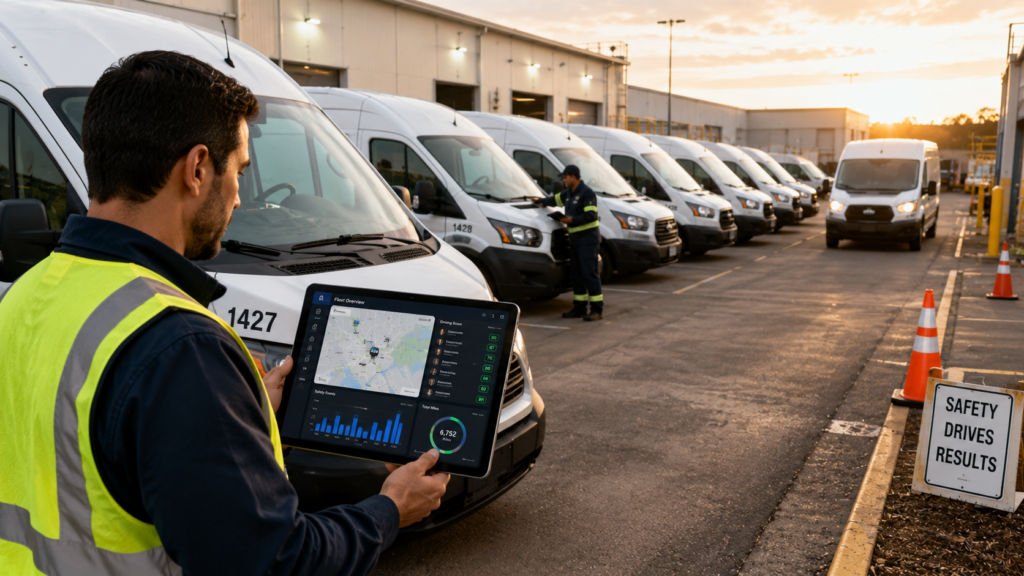
Commercial auto insurance has traditionally looked backward.
What you’ll understand
- Business Insurance Risk Explorer
- What Is Commercial Auto Telematics?
- Traditional Insurance vs. Usage-Based Insurance
Insurers examine:
Past accidents + claims history + vehicle types + driver records + operating territory
and use those factors to estimate what might happen next.
Business Insurance Risk Explorer
Select the exposures that apply to your business.
This is an educational risk-mapping tool, not a coverage recommendation. Requirements and suitable limits depend on the business, contracts, jurisdiction and policy terms.
Telematics changes the equation.
Instead of asking only:
“What happened to this fleet during the last five years?”
insurers can increasingly ask:
“How are these vehicles being driven today?”
Modern telematics can measure mileage, driving times, rapid acceleration, hard braking, hard cornering and other driving characteristics. The NAIC explains that usage-based insurance can use this information to align premiums more closely with actual driving behavior.
For businesses operating:
- Delivery vans
- Service vehicles
- Contractors’ trucks
- Sales fleets
- Commercial cars
- Light trucks
- Regional transportation fleets
this can create an opportunity.
A company with demonstrably safer drivers may be able to turn:
good driving → better risk profile → potentially better insurance economics.
But telematics is not simply about installing GPS trackers.
The real value comes from what the business does with the data.
What Is Commercial Auto Telematics?
Telematics combines:
Vehicle + sensors + GPS + communications + data analytics.
Depending on the system, information can come from:
- Built-in vehicle technology
- Plug-in devices
- Hardwired equipment
- Smartphones
- Fleet-management platforms
The information is transmitted to software that analyzes vehicle use and driver behavior.
The NAIC identifies telematics measurements including:
Mileage
How far the vehicle travels.
Time of day
When driving occurs.
Location
Where vehicles operate.
Rapid acceleration
How frequently drivers accelerate aggressively.
Hard braking
How frequently drivers brake suddenly.
Hard cornering
Potentially risky turning behavior.
Airbag deployment
Information potentially useful after an accident.
More advanced commercial platforms can combine this information with broader fleet-management data.
Traditional Insurance vs. Usage-Based Insurance
Consider two plumbing companies.
Plumbing Company A
- 20 vans
- Drivers average 10,000 miles annually.
- Most driving occurs during daylight.
- Low harsh-braking frequency.
- Strong safety program.
- Few claims.
Plumbing Company B
- 20 vans
- Drivers average 30,000 miles annually.
- Significant late-night driving.
- Frequent hard braking.
- Aggressive acceleration.
- Multiple claims.
Traditional rating methods certainly won’t treat every fleet identically.
But telematics can give insurers considerably more detailed information about how vehicles are actually being operated.
The basic UBI principle is:
Lower demonstrated risk → potentially more favorable pricing.
The NAIC says telematics allows insurers to use real-time driver behavior and usage information to price risk more accurately and provide premium discounts in appropriate programs.
Why Commercial Auto Insurance Is a Major Business Expense
A fleet accident can generate much more than a repair bill.
One crash can potentially involve:
- Vehicle damage
- Third-party property damage
- Bodily injury
- Medical expenses
- Legal defense
- Lost productivity
- Vehicle downtime
- Replacement rental
- Cargo damage
A serious liability claim can be especially expensive.
That means reducing accident frequency can have value beyond an insurance discount.
The better objective is:
Reduce losses first.
Potential insurance savings can follow.
Telematics 1.0 Was Mostly About Location
Early fleet telematics often answered relatively simple questions:
Where is the truck?
Where has it been?
How many miles did it travel?
This was extremely useful for:
- Dispatch
- Route planning
- Vehicle recovery
- Mileage records
But today’s systems can potentially provide much richer information.
Telematics 2.0 Is About Behavior
Modern fleet systems can potentially identify patterns such as:
Driver 1
Low-risk behavior.
Driver 2
Frequent hard braking.
Driver 3
Repeated speeding events.
Driver 4
High mileage.
Driver 5
Frequent aggressive acceleration.
Instead of managing fleet risk only after an accident, companies can potentially intervene:
before the accident happens.
That is the biggest difference.
Hard Braking Can Be an Early Warning
One hard-braking event doesn’t necessarily mean someone is a dangerous driver.
Perhaps:
another vehicle cut them off.
But repeated events can reveal a pattern.
Imagine:
Driver A: 3 harsh-braking events per 1,000 miles
versus:
Driver B: 35 events per 1,000 miles.
Driver B may deserve additional review.
Perhaps they are:
- Following too closely
- Driving too fast
- Distracted
- Operating on difficult routes
Telematics helps managers identify the pattern.
Speeding Matters
Commercial drivers often face schedule pressure.
A delivery driver may think:
“If I drive a little faster, I’ll finish the route earlier.”
But faster driving can increase accident severity and potentially contribute to more dangerous situations.
Telematics can help fleet managers identify repeated speeding patterns and coach drivers accordingly.
The objective should not be:
Catch the employee.
It should be:
Identify risk → coach driver → improve behavior → prevent crash.
Mileage Matters Too
A vehicle traveling:
5,000 miles annually
doesn’t have the same road exposure as one traveling:
50,000 miles annually.
The NAIC notes a strong relationship between mileage and claims/loss costs, which is one reason mileage is an important component of many usage-based programs.
For fleets whose vehicles are used irregularly, accurate mileage information can potentially be especially valuable.
Pay-As-You-Drive vs. Pay-How-You-Drive
These concepts are related but different.
Pay-As-You-Drive
Pricing emphasizes:
How much you drive.
Lower mileage may potentially mean lower cost.
Pay-How-You-Drive
Pricing considers:
How you drive.
That can include:
- Braking
- Acceleration
- Cornering
- Speed
- Driving time
The NAIC identifies multiple UBI structures, including Pay-As-You-Drive and Pay-How-You-Drive.
Modern programs can combine both concepts.
Why the 20% Number Needs Caution
Suppose your current commercial auto premium is:
$100,000 per year.
A 20% reduction would equal:
$20,000.
That’s attractive.
But businesses should never assume:
Telematics installed = automatic 20% discount.
Actual results can depend on:
- Insurer
- State
- Fleet size
- Vehicle class
- Driving behavior
- Mileage
- Claims history
- Program rules
- Underwriting
- Regulatory requirements
Some drivers or fleets may receive meaningful savings.
Others may receive less.
And depending on the program, poor driving data may affect pricing unfavorably.
The NAIC explicitly warns consumers that UBI does not guarantee lower premiums and that driving behavior can potentially lead to higher premiums in some programs.
The Bigger Savings May Come From Fewer Accidents
This is where fleet managers should look beyond the insurance invoice.
Suppose telematics helps reduce:
speeding + harsh braking + distracted driving + unnecessary mileage.
That can potentially reduce:
- Collisions
- Fuel use
- Maintenance
- Tire wear
- Vehicle downtime
- Workers’ compensation incidents
- Liability claims
The NAIC notes that telematics can also help fleets identify efficient routes, potentially reducing personnel, fuel and maintenance costs.
So even if the insurance discount is modest, operational savings may still make the technology valuable.
Example: A 50-Vehicle Service Fleet
Consider a hypothetical HVAC company.
It operates:
50 service vans.
Annual commercial auto premium:
$175,000.
Management introduces telematics.
During the first month, the system identifies:
- 11 drivers with frequent hard braking
- 8 with repeated speeding events
- 6 with unnecessary idling
- 4 with inefficient routes
Instead of punishing employees, management starts monthly coaching.
After six months:
harsh driving declines
speeding declines
mileage becomes more efficient
accident frequency improves.
At renewal, the company can present its broker and insurer with actual risk-management information.
That doesn’t guarantee a particular premium reduction.
But the business is in a stronger position than simply saying:
“We think our drivers are safe.”
It has data.
Data Can Improve the Renewal Conversation
Traditional insurance renewal discussions can sometimes look like:
Insurer: Your loss history is poor.
Business: We’ve improved safety.
Insurer: Prove it.
Telematics potentially provides that evidence.
The company can demonstrate:
Driver coaching completed
Speeding events down
Harsh braking down
Mileage controlled
Safety scores improving
Claims trending downward
This can give the broker better information when presenting the risk to insurers.
Telematics Can Help After an Accident
Consider this scenario.
A company driver says:
“I was traveling within the speed limit when another car pulled in front of me.”
The other driver says:
“The commercial van was speeding.”
Telematics data may potentially provide useful information about:
- Speed
- Location
- Time
- Braking
- Vehicle movement
The NAIC notes that telematics can help insurers analyze driving data around an accident and potentially improve damage assessment and fraud detection.
Depending on the system, businesses may also combine telematics with dashcam footage.
Video Telematics Adds Another Layer
Modern commercial fleets increasingly combine:
Vehicle data + camera information.
This may help identify:
- Distracted driving
- Following distance
- Road conditions
- Collision circumstances
- Unsafe behavior
But video introduces additional considerations involving:
privacy + employee monitoring + data retention + cybersecurity.
Businesses should establish clear policies before deploying driver-facing cameras.
Telematics Can Help Identify Distracted Driving
Phone distraction is particularly dangerous for commercial fleets.
Some modern systems may identify:
- Phone handling
- Driver distraction
- Unsafe following
- Seatbelt behavior
When appropriate technology and policies are used, fleet managers can coach drivers before risky behavior produces an accident.
Again, the objective should be:
prevention rather than surveillance for its own sake.
Driver Coaching Is Where the Real Value Appears
Installing a device doesn’t automatically make drivers safer.
Imagine:
Telematics installed January 1.
The dashboard generates:
15,000 alerts.
Nobody reviews them.
Nothing changes.
The company has collected:
data
but hasn’t created:
risk management.
A stronger process is:
Detect → Review → Coach → Measure → Improve.
Don’t Punish Every Alert
Telematics data requires context.
Hard braking might mean:
aggressive driving
or:
avoiding a child running into the road.
Managers shouldn’t treat every alert as proof of misconduct.
Look for:
patterns.
A driver with one event isn’t necessarily concerning.
A driver with consistently poor behavior may require intervention.
Create a Driver Scorecard
A fleet could track:
| Metric | Driver A | Driver B |
|---|---|---|
| Speeding Events | 2 | 24 |
| Harsh Braking | 4 | 31 |
| Rapid Acceleration | 3 | 19 |
| Seatbelt Compliance | 99% | 87% |
| Safety Trend | Improving | Declining |
The precise metrics should match the technology and company’s operations.
Managers can then focus coaching where it matters.
Reward Good Drivers Too
Telematics shouldn’t only identify problems.
It can identify excellent drivers.
Consider recognition for:
- Safe-driving streaks
- Improved safety scores
- Accident-free performance
- Consistent seatbelt use
- Reduced harsh-driving events
Positive reinforcement can help create a:
safety culture
rather than:
surveillance culture.
Route Optimization Can Reduce Exposure
Suppose your fleet collectively drives:
2 million miles annually.
Improved routing reduces that by:
100,000 miles.
That can mean:
- Less fuel
- Less maintenance
- Less driver time
- Less road exposure
The NAIC specifically recognizes route efficiency as a potential fleet benefit of telematics.
Insurance savings are therefore only one component of the business case.
Maintenance Data Can Help Too
Some fleet-management platforms can monitor vehicle information that may help identify maintenance needs.
That can help businesses address issues before a breakdown creates:
roadside incident + missed delivery + towing + downtime.
Preventive maintenance can also support broader fleet safety.
Telematics Can Help Fight Vehicle Theft
GPS-based vehicle location may help businesses recover stolen commercial vehicles.
The NAIC identifies vehicle theft recovery as one of the ancillary benefits associated with telematics technology.
For fleets with expensive:
trucks + equipment + tools
this can be valuable beyond insurance pricing.
Privacy Is the Big Trade-Off
Telematics works because it collects data.
That raises an obvious question:
How much monitoring is too much?
Depending on the system, information could include:
- Vehicle location
- Driving times
- Routes
- Speed
- Driver behavior
- Phone interaction
- Video
The NAIC recognizes privacy as one of the major challenges surrounding telematics and usage-based insurance.
Businesses should be transparent about what is collected and why.
Employees Should Know What Is Being Monitored
A telematics policy should explain:
What data is collected?
When is it collected?
Why is it collected?
Who can access it?
How long is it retained?
Is it shared with the insurer?
Can it be used for disciplinary decisions?
Are cameras involved?
This is particularly important if employees can take company vehicles home.
After-Hours Tracking Can Be Sensitive
Suppose an employee is permitted personal use of a company vehicle.
The telematics device operates:
24/7.
The company could potentially see:
- Evening trips
- Weekend locations
- Personal destinations
That creates legitimate privacy concerns.
Businesses should obtain appropriate employment and privacy advice before implementing monitoring programs, especially when personal vehicle use is permitted.
Cybersecurity Matters
Fleet telematics generates valuable information.
A system can contain:
vehicle locations + routes + employee information + operating schedules.
That data should be protected.
Ask vendors about:
- Encryption
- Authentication
- Access controls
- Data storage
- Breach notification
- Security testing
- Data retention
Your fleet-management system shouldn’t become a new cybersecurity weakness.
Who Owns the Data?
This question should be answered before signing the telematics contract.
Is the data owned by:
Your business?
The telematics provider?
The insurer?
Can the vendor:
sell it?
aggregate it?
retain it after termination?
use it to train algorithms?
Review vendor terms carefully.
Don’t Install Telematics Only for the Discount
This is perhaps the most important practical advice.
If your entire strategy is:
Install device → get discount,
you’re missing most of the value.
A stronger strategy is:
Install telematics
↓
Establish baseline
↓
Identify risky drivers
↓
Coach drivers
↓
Improve routes
↓
Reduce mileage
↓
Reduce accidents
↓
Document improvement
↓
Present better risk to insurer
The insurance benefit becomes part of a larger fleet-safety program.
Which Fleets May Benefit Most?
Telematics may be particularly worth evaluating for businesses with:
- Multiple commercial vehicles
- High annual mileage
- Delivery operations
- Service technicians
- Construction vehicles
- Sales fleets
- Distributed drivers
- Expensive commercial auto premiums
- Recent accident problems
It can also be useful for smaller fleets where the owner cannot personally observe every driver’s behavior.
Telematics Isn’t Right for Every Fleet
There can be costs.
Businesses may face:
- Hardware expense
- Software subscriptions
- Installation
- Management time
- Driver training
- Privacy concerns
- Data-management requirements
If a company operates:
two vehicles
with very limited mileage, the economics may differ from a:
500-vehicle fleet.
Calculate total value rather than chasing a percentage discount.
2026 Fleet Telematics Checklist
Before implementing a program:
- Ask your insurer whether it offers commercial UBI.
- Ask whether telematics can reduce premiums.
- Ask whether poor scores can increase premiums.
- Identify exactly what data is collected.
- Review privacy requirements.
- Create an employee telematics policy.
- Establish a baseline safety score.
- Monitor speeding.
- Monitor harsh braking.
- Monitor rapid acceleration.
- Review mileage.
- Review after-hours driving.
- Evaluate route efficiency.
- Create driver coaching.
- Reward strong performance.
- Review accident trends.
- Establish data-retention rules.
- Review vendor cybersecurity.
- Review data ownership.
- Review dashcam requirements.
- Document safety improvements.
- Provide results to your broker.
- Compare insurers at renewal.
- Calculate total fleet savings—not only premium savings.
Questions to Ask Your Commercial Auto Broker
- Does the insurer offer telematics-based commercial auto pricing?
- What maximum discount is available?
- Is the discount guaranteed?
- Can telematics increase our premium?
- Which driving behaviors affect pricing?
- Does mileage affect pricing?
- Does driving time matter?
- How long must data be collected?
- Who owns the telematics data?
- Does the insurer receive raw data?
- Can telematics data be used during claims?
- Are dashcams required?
- Are there installation costs?
- Are there fleet-size requirements?
- Does participation affect renewal underwriting?
- Can safety improvements help us obtain better quotes elsewhere?
- Are discounts available in every state where we operate?
- How are multiple drivers per vehicle handled?
- What happens if a device stops transmitting?
- Can we leave the program later?
Frequently Asked Questions
What is usage-based commercial auto insurance?
Usage-based insurance uses information about vehicle usage and/or driving behavior to help determine insurance pricing. Telematics technology commonly supplies that information.
Can telematics reduce commercial auto premiums?
Potentially. Lower-risk driving can qualify for more favorable pricing under some usage-based programs, but discounts vary by insurer, jurisdiction and performance.
Can telematics save my fleet exactly 20%?
Don’t assume so. A 20% figure should be treated as an example or program-specific possibility, not a universal guarantee.
What does commercial telematics monitor?
Depending on the program, it can monitor mileage, time of day, location, acceleration, braking, cornering and other driving characteristics.
Can my premium increase?
Potentially, depending on the specific program. The NAIC advises that usage-based programs don’t necessarily benefit every driver and that poor driving behavior can result in unfavorable pricing under some programs.
Does telematics use GPS?
Many systems can collect GPS/location information, although the exact information collected depends on the technology and program.
Is telematics only useful for insurance?
No. Fleet operators can also use telematics for route efficiency, safety monitoring, vehicle location and other operational purposes.
Does telematics prevent accidents?
A device itself doesn’t prevent an accident. The value comes from using the information to identify risky behavior, coach drivers and improve fleet operations.
Are there privacy concerns?
Yes. Location and driver-behavior monitoring create privacy considerations. Businesses should understand applicable laws and communicate monitoring practices clearly.
Should a small business use telematics?
It can be worthwhile, especially when commercial auto costs or accident frequency are significant. Compare potential insurance and operational savings with technology and management costs.
Final Thoughts
Commercial auto insurance used to depend heavily on:
who you are + what you drive + where you operate + what happened in the past.
Telematics adds another dimension:
How are your vehicles actually being driven?
For a well-managed fleet, that can be powerful.
Instead of telling an insurer:
“Our drivers are safer now,”
you may be able to demonstrate:
Speeding ↓
Hard braking ↓
Unnecessary mileage ↓
Risky driving ↓
Accidents ↓
The NAIC notes that telematics can allow insurers to more closely connect premiums with actual driving performance while also helping fleets optimize routes and reduce fuel and maintenance costs.
But don’t build the business case around a promised 20% discount.
Build it around:
Safer drivers → fewer accidents → lower operating costs → better loss history → stronger insurance position.
If a substantial insurance discount follows, that’s an additional benefit.
Key terms in this guide
Tap a term to review the plain-English meaning while you read.
Premium
The amount charged for insurance coverage, usually paid monthly, quarterly or annually.
Underwriting
The process an insurer uses to evaluate risk and decide whether and on what terms to offer coverage.
Claim
A request for payment or benefits under an insurance policy after an event that may be covered.
Liability
Legal responsibility for injury, damage or loss suffered by another person or organization.
Workers’ Compensation
A state-based system that can provide benefits for qualifying work-related injuries or occupational illnesses.
Did the guide make sense?
Answer two quick questions. Your score stays in this browser.
Verify Current Rules
Insurance rules, benefits and product terms can change. These official resources are useful starting points for checking current requirements; they do not replace your policy documents or jurisdiction-specific advice.
Thanks — your response is saved in this browser.
Continue learning, not just scrolling
Follow a practical path from understanding the idea to comparing options and preparing for real-world decisions.
 StartWorkers’ Compensation Insurance Guide: Coverage, Benefits, Costs, and Employer ResponsibilitiesBuild the foundation →
 CompareCannabis Business Insurance: Navigating federal vs. state gaps for dispensaries in legal states.Compare your options →
 PlanGeneral Liability Insurance Guide: What It Covers, Costs and Why Businesses Need ItUnderstand the numbers →
 ActBusiness Interruption Insurance Explained: Coverage, Claims, Costs and Common GapsBe ready for a claim →
Leave a Comment
Share a helpful question or experience. Your email address will not be published.