
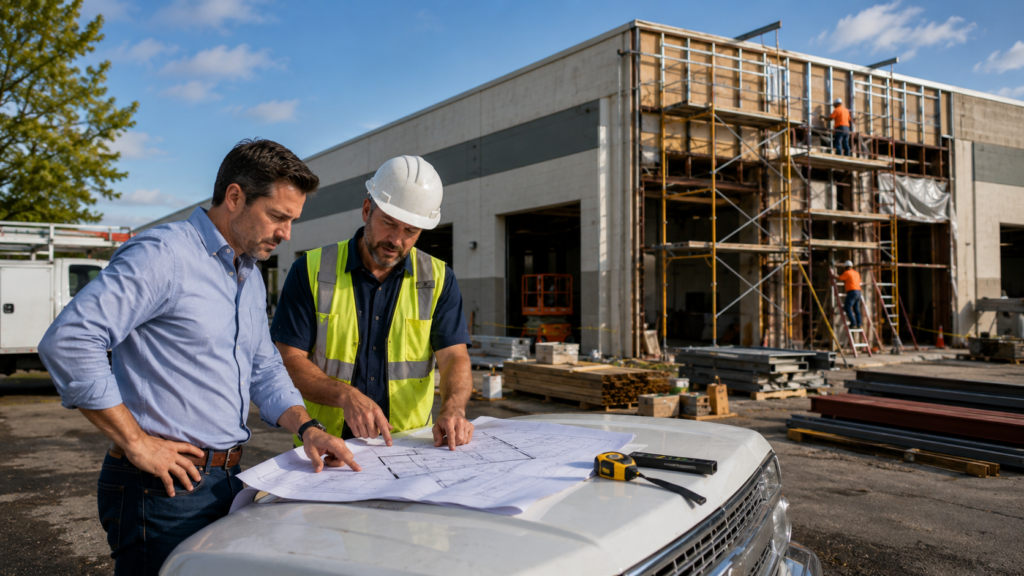
Imagine your business owns a commercial building insured for:
What you’ll understand
- Business Insurance Risk Explorer
- Why Businesses Become Underinsured
- Construction Labor Is Part of the Problem
$1.5 million.
The policy has been renewed every year, premiums have been paid on time, and the limit still looks substantial.
Then a major fire destroys the property.
Business Insurance Risk Explorer
Select the exposures that apply to your business.
This is an educational risk-mapping tool, not a coverage recommendation. Requirements and suitable limits depend on the business, contracts, jurisdiction and policy terms.
Contractors estimate that rebuilding the same structure will now cost:
$2 million.
Suddenly, your $1.5 million policy limit doesn’t look nearly as comfortable.
You may have a:
$500,000 insurance gap.
That’s the commercial-property underinsurance trap.
And even though commercial-property insurance pricing has softened significantly in 2026, reconstruction costs have not simply returned to their old levels.
What Is Commercial Property Underinsurance?
Underinsurance occurs when the amount of insurance carried on a building or other property is insufficient relative to the amount required under the policy or the cost of replacing the insured property after a covered loss.
For example:
Current estimated replacement cost: $2,000,000
Building insurance limit: $1,500,000
Potential valuation gap:
$500,000
That doesn’t necessarily mean every claim will automatically be reduced by $500,000. The actual claim outcome depends on the policy’s terms, limits, valuation provisions, coinsurance requirements, deductibles and circumstances of the loss.
But the mismatch creates potentially serious financial exposure.
Replacement Cost Is Not the Same as Market Value
This is one of the most important concepts for commercial-property owners.
Suppose you could sell your building today for:
$1.2 million.
That does not necessarily mean you should insure it for $1.2 million.
The cost to reconstruct it after a total loss could be:
$1.8 million.
Market value considers factors such as:
- Location
- Land value
- Local property demand
- Rental income
- Economic conditions
Replacement cost focuses on what it would cost to rebuild or replace the insured property.
The Insurance Information Institute explains that replacement-cost coverage pays to rebuild or repair covered property based on current construction costs, while actual cash value generally accounts for depreciation.
Construction Costs Are Still Rising in 2026
Construction-cost inflation has moderated.
But moderated does not mean reversed.
Verisk’s Q2 2026 reconstruction-cost analysis found that total U.S. commercial reconstruction costs increased 4.1% from April 2025 to April 2026.
The increase varied considerably by state.
For example:
Rhode Island: +6.36%
Oklahoma: +5.81%
Iowa: +5.22%
Other states experienced considerably smaller increases.
Verisk’s earlier Q1 report similarly found overall U.S. reconstruction costs—including residential and commercial—were still increasing year over year, even though the pace of inflation had slowed.
Why a 4% Increase Can Matter
Four percent may not sound dramatic.
But commercial buildings involve large numbers.
Suppose rebuilding a property cost:
$5 million
last year.
A 4.1% increase would represent approximately:
$205,000
in additional cost.
Estimated replacement cost:
$5,205,000
And that is only an illustration based on the national change.
Actual rebuilding costs depend on:
- Location
- Building type
- Materials
- Labor
- Equipment
- Contractor availability
- Building codes
- Catastrophe conditions
Small percentage changes can translate into large dollar amounts.
Why Businesses Become Underinsured
Underinsurance rarely happens because an owner deliberately chooses inadequate protection.
More often, property values simply become outdated.
1. The Building Hasn’t Been Valued Recently
A company purchases a warehouse.
Replacement cost is estimated at:
$3 million.
Five years later, the policy still reflects a similar value even though construction costs have changed substantially.
The building didn’t change.
But the cost of rebuilding it did.
2. Renovations Were Never Reported
Suppose you add:
- New production equipment
- HVAC systems
- Electrical upgrades
- Commercial kitchen
- Storage area
- Office extension
- Solar panels
Your building may now cost significantly more to replace.
If your insurer doesn’t know about the improvements, your policy limits may no longer reflect the actual exposure.
3. Equipment Values Are Outdated
Underinsurance isn’t limited to the building.
Commercial property can also include:
- Machinery
- Computers
- Furniture
- Inventory
- Tools
- Production equipment
Marsh’s Q1 2026 property-valuation update specifically cautions that equipment and contents cost trends can differ from general building-cost trends and recommends using industry-specific information rather than automatically applying one broad inflation percentage.
4. Owners Confuse Purchase Price With Replacement Cost
You bought a property for:
$900,000.
That doesn’t automatically mean:
$900,000 = correct insurance limit.
Part of the purchase price may represent land.
Conversely, rebuilding the structure could cost substantially more than its current market value.
Insurance valuation requires a different calculation.
Construction Labor Is Part of the Problem
Rebuilding isn’t only about:
bricks + steel + lumber.
You also need people.
Construction requires:
- Electricians
- Plumbers
- Carpenters
- Equipment operators
- Engineers
- Contractors
- Project managers
Verisk’s Q1 2026 report noted persistent construction labor constraints even as broader reconstruction-cost inflation moderated.
A shortage of skilled labor can increase rebuilding costs and potentially extend reconstruction timelines.
Catastrophes Can Create Demand Surges
Normal construction cost and post-catastrophe reconstruction cost aren’t always identical.
Imagine a hurricane damages thousands of buildings in one region.
Suddenly everyone needs:
- Roofers
- Electricians
- Contractors
- Lumber
- Drywall
- Equipment
at the same time.
Local demand can surge.
That can affect:
price + availability + rebuilding time.
A property valuation that looks adequate under ordinary conditions may therefore deserve additional scrutiny in catastrophe-exposed areas.
What Is Coinsurance?
Coinsurance is one of the most misunderstood commercial-property provisions.
A commercial property policy may require the insured to maintain insurance equal to a specified percentage of the property’s value.
Common percentages can include:
80%
90%
or
100%
depending on the policy.
Failing to satisfy the requirement can potentially reduce the amount recoverable for a partial loss.
The exact calculation depends on the policy.
Simple Coinsurance Example
Assume, purely for illustration:
Replacement value: $2,000,000
Coinsurance requirement: 80%
Required insurance:
$1,600,000
But the business carries only:
$1,200,000.
Now suppose there is a covered:
$400,000 loss.
Simplified coinsurance calculation:
$1,200,000 ÷ $1,600,000 = 75%
75% × $400,000 = $300,000
Before considering the deductible and other policy provisions, the simplified calculation illustrates how inadequate limits can potentially affect even a partial loss.
This is why underinsurance isn’t only a total-loss problem.
Check Your Policy Rather Than Assuming
Not every commercial-property policy works identically.
Your policy may contain:
- Coinsurance provisions
- Agreed-value provisions
- Replacement-cost provisions
- Actual-cash-value provisions
- Inflation adjustments
- Blanket limits
- Specific limits
- Margin clauses
- Ordinance-or-law coverage
- Extended replacement provisions
Never assume that a general example describes your policy.
Read the actual contract.
What Is Agreed Value?
Some commercial-property programs may offer an agreed-value arrangement that can suspend application of a coinsurance provision for a specified period when policy requirements are satisfied.
That doesn’t mean:
“Valuation no longer matters.”
Quite the opposite.
The insurer may require accurate statements of property values.
If those values are outdated, the overall insurance program can still be inadequate after a major loss.
What About Inflation Guard?
Some policies include provisions designed to increase building limits over time.
The Insurance Information Institute notes that some commercial property coverage automatically increases building limits by a set percentage to help keep pace with rising rebuilding costs.
That’s useful.
But don’t assume an automatic percentage guarantees adequate coverage.
Your actual costs may increase faster because of:
- Major renovations
- Local construction inflation
- Specialized materials
- Equipment costs
- Code requirements
Automatic adjustments aren’t a substitute for periodic valuation reviews.
Ordinance or Law Can Create Another Gap
Imagine your building was constructed in:
1985.
A major covered fire destroys half of it.
Today’s building code may require upgrades involving:
- Electrical systems
- Fire protection
- Accessibility
- Structural standards
- Energy efficiency
Rebuilding to modern codes can cost more than simply reproducing the old building.
Standard property coverage may not fully address every additional ordinance-or-law expense.
Businesses should discuss appropriate:
Ordinance or Law Coverage
with their insurance professional.
Debris Removal Can Be Expensive
Before rebuilding begins, damaged material may need to be:
- Demolished
- Removed
- Transported
- Disposed of
Major commercial losses can produce substantial debris-removal expenses.
Policyholders should understand how their policy treats these costs and whether limits or additional amounts apply.
Don’t Forget Business Personal Property
Your building may be correctly insured while everything inside it is underinsured.
Consider a manufacturing facility containing:
Building: $4 million
Machinery: $2 million
Inventory: $1 million
Computers/furniture: $300,000
Total property exposure is far greater than the building alone.
If machinery prices increase but policy values aren’t updated, the company can still have a substantial insurance gap.
Inventory Can Change During the Year
Some businesses have seasonal inventory.
Imagine a retailer normally carries:
$300,000
of inventory.
Before the holiday season:
$850,000.
A fire in November could create a much larger loss than a fire in February.
Businesses with fluctuating inventory should discuss options such as:
- Peak-season endorsements
- Reporting forms
- Appropriate blanket limits
depending on the insurer and policy structure.
Specialized Equipment Can Be Difficult to Replace
Suppose your factory relies on a machine purchased five years ago for:
$250,000.
A replacement now costs:
$400,000.
It must also be:
- Imported
- Transported
- Installed
- Calibrated
The true replacement exposure may therefore exceed the equipment’s original purchase price.
This is why Marsh recommends treating equipment and contents valuations carefully rather than applying a generic construction-cost index to every asset.
Underinsurance Can Affect Business Interruption Too
A building loss doesn’t only cost money to repair.
Your business may also stop operating.
Suppose a fire closes a manufacturing facility for:
nine months.
During that period the company may continue facing:
- Payroll
- Rent or loan payments
- Taxes
- Certain utilities
- Other continuing expenses
while losing revenue.
Business income insurance can help with qualifying losses, subject to policy terms.
But businesses should review the period of restoration and business-income values alongside physical property limits.
Reconstruction Time Matters
A business owner might assume:
“We’ll rebuild in six months.”
But a major commercial reconstruction can involve:
- Damage assessment
- Demolition
- Engineering
- Permits
- Contractor selection
- Materials procurement
- Construction
- Equipment installation
- Inspections
- Reopening
A catastrophe can make the timeline even longer.
The financial impact of a loss therefore involves both:
cost to rebuild + time to rebuild.
Falling Insurance Rates Don’t Mean Falling Replacement Costs
This distinction is especially important in 2026.
Marsh reported that U.S. property insurance rates fell 13% in Q2 2026 as insurer capacity and competition increased. Globally, property rates declined 12%.
At the same time, Verisk reported U.S. commercial reconstruction costs were 4.1% higher year over year in April 2026.
So we can simultaneously have:
Insurance pricing ↓
while:
Reconstruction costs ↑
There is no contradiction.
Insurance rate and insured value are different things.
Don’t Reduce Limits Just Because Your Premium Fell
Suppose your broker obtains a 12% property rate reduction.
Excellent.
That doesn’t mean you should reduce your:
$5 million building limit to $4.4 million
to save even more.
The limit should reflect appropriate property valuation and policy requirements—not simply the premium you want to pay.
Marsh’s Q1 2026 valuation update emphasizes that accurate property values remain important to insurers even as market conditions improve.
The Underinsurance Problem Is Not Theoretical
The Insurance Information Institute has highlighted commercial-property undervaluation as an important industry issue.
Its commercial-property trends report cited a Kroll appraisal study indicating that approximately 90% of buildings studied were underinsured, with 68% of buildings valued during 2020–2021 underinsured by at least 25%.
That doesn’t mean 90% of every commercial building in America is currently underinsured.
The figure refers to the buildings in that appraisal study.
But it demonstrates how significant valuation gaps can become.
Example: The Underinsured Warehouse
Consider a fictional wholesale company.
The warehouse was last professionally valued in 2021 at:
$4 million.
The owner renews the policy each year without performing another detailed valuation.
By 2026, assume an updated professional estimate determines the reconstruction cost is:
$5 million.
Insurance limit:
$4 million
Potential valuation gap:
$1 million.
Then a severe fire occurs.
Even though the owner:
- Paid every premium
- Had replacement-cost coverage
- Never missed a renewal
the policy’s available limit may still be insufficient to fund the entire reconstruction.
Replacement-cost coverage doesn’t create an unlimited pool of money.
Policy limits still matter.
How Often Should Commercial Property Be Revalued?
There isn’t one universal timetable suitable for every property.
However, businesses should review valuations regularly and particularly after significant changes.
Marsh recommends periodically reviewing and updating property values with valuation support when necessary.
A review becomes particularly important after:
- Renovation
- Expansion
- New machinery
- Major inventory changes
- Construction-cost spikes
- Acquisition
- Change in occupancy
- Significant building-code changes
Large or complex properties may justify professional appraisal or replacement-cost analysis.
What Should Be Included in a Property Valuation?
Depending on the business, review:
Building
- Structure
- Permanently installed systems
- Improvements
Business Personal Property
- Furniture
- Computers
- Machinery
- Equipment
- Tools
Inventory
- Raw materials
- Work in progress
- Finished goods
Special Property
- Specialized machinery
- Outdoor property
- Signs
- Valuable records
The policy itself determines what property is covered and how it is valued.
2026 Commercial Property Review Checklist
Before your next renewal:
- Check the current building limit.
- Obtain an updated replacement-cost estimate where appropriate.
- Don’t use market value as a substitute for reconstruction cost.
- Review renovations completed since the last valuation.
- Update machinery and equipment values.
- Review inventory limits.
- Check seasonal inventory exposure.
- Understand replacement cost vs. actual cash value.
- Review your coinsurance percentage.
- Ask whether agreed value applies.
- Review inflation-guard provisions.
- Check ordinance-or-law coverage.
- Review debris-removal provisions.
- Review business-income limits.
- Consider realistic reconstruction timelines.
- Review catastrophe exposure.
- Update valuations after major property changes.
- Keep asset records and invoices.
- Discuss valuation assumptions with your broker.
- Review the policy annually.
Questions to Ask Your Insurance Broker
At your next commercial-property renewal, ask:
- What replacement cost is currently being used for my building?
- When was that valuation last updated?
- What construction-cost data supports it?
- Does my policy contain coinsurance?
- What percentage applies?
- Does agreed value apply?
- Is there an inflation-guard provision?
- Are recent renovations included?
- Are my machinery values current?
- Is my inventory adequately insured?
- What ordinance-or-law coverage do I have?
- How is debris removal covered?
- Is business-income coverage adequate for today’s rebuilding timeline?
- Would a professional property valuation be appropriate?
- What happens if actual reconstruction costs exceed my policy limit?
Frequently Asked Questions
What does underinsured mean in commercial property insurance?
Generally, it means the amount of insurance carried is insufficient relative to the property’s replacement exposure or the amount required under applicable policy provisions.
Are U.S. commercial reconstruction costs still rising in 2026?
Yes. Verisk reported commercial reconstruction costs increased 4.1% nationally from April 2025 to April 2026, although changes varied significantly by state.
Are commercial-property insurance rates rising in 2026?
Not broadly in Marsh’s latest index. U.S. property insurance rates fell approximately 13% in Q2 2026, reflecting greater capacity and competition.
How can construction costs rise while property insurance rates fall?
They measure different things. Insurance rates reflect insurance-market pricing, while replacement costs reflect the expense of reconstructing property.
Is replacement cost the same as market value?
No. Market value represents what property might sell for, while replacement cost generally reflects the cost of replacing or reconstructing insured property.
Does replacement-cost insurance guarantee my entire building will be rebuilt?
Not necessarily. Policy limits, deductibles, exclusions, valuation conditions and other policy terms still apply.
What is a coinsurance penalty?
When a policy contains a coinsurance requirement and the insured doesn’t maintain the required amount of insurance, the recoverable amount for certain losses may be reduced according to the policy’s formula.
Should I automatically increase my property limit by 4.1%?
No. The 4.1% Verisk figure is a national commercial reconstruction-cost trend, not a valuation for your specific property. Location, construction, equipment and other characteristics matter.
Does inflation guard prevent underinsurance?
It can help limits keep pace with some cost increases, but it doesn’t guarantee that the resulting limit accurately reflects the property’s current replacement cost.
Should I professionally value my commercial building?
For significant or complex properties, a professional valuation can help establish more reliable replacement-cost estimates. Verisk and Marsh both emphasize the importance of accurate insurance-to-value assessments.
Final Thoughts
The commercial-property market presents an unusual opportunity in 2026.
Insurance pricing has become more competitive.
Marsh reported U.S. property rates declined approximately 13% in Q2 2026.
But don’t confuse:
cheaper insurance rates
with
cheaper buildings to reconstruct.
Verisk’s latest Q2 analysis shows U.S. commercial reconstruction costs remained 4.1% higher year over year as of April 2026.
That means the smartest renewal strategy isn’t necessarily:
Reduce the limit to reduce the premium.
It is:
Verify the value → Understand the policy → Maintain appropriate limits → Then negotiate the rate.
A commercial property policy can only protect your business effectively when the values behind it reflect the assets you’re actually trying to replace.
Key terms in this guide
Tap a term to review the plain-English meaning while you read.
Premium
The amount charged for insurance coverage, usually paid monthly, quarterly or annually.
Deductible
The amount you may need to pay toward a covered loss before the insurer pays under the policy, subject to the policy terms.
Policy Limit
The maximum amount an insurer may pay for a covered loss or category of loss under the policy.
Exclusion
A policy provision that removes specified situations, causes, property, people or losses from coverage.
Endorsement
A document that changes, adds to or removes terms from the standard insurance policy.
Claim
A request for payment or benefits under an insurance policy after an event that may be covered.
Did the guide make sense?
Answer two quick questions. Your score stays in this browser.
Verify Current Rules
Insurance rules, benefits and product terms can change. These official resources are useful starting points for checking current requirements; they do not replace your policy documents or jurisdiction-specific advice.
Thanks — your response is saved in this browser.
Continue learning, not just scrolling
Follow a practical path from understanding the idea to comparing options and preparing for real-world decisions.
 StartWorkers’ Compensation Insurance Guide: Coverage, Benefits, Costs, and Employer ResponsibilitiesBuild the foundation →
 CompareCannabis Business Insurance: Navigating federal vs. state gaps for dispensaries in legal states.Compare your options →
 PlanGeneral Liability Insurance Guide: What It Covers, Costs and Why Businesses Need ItUnderstand the numbers →
 ActBusiness Interruption Insurance Explained: Coverage, Claims, Costs and Common GapsBe ready for a claim →
Leave a Comment
Share a helpful question or experience. Your email address will not be published.