
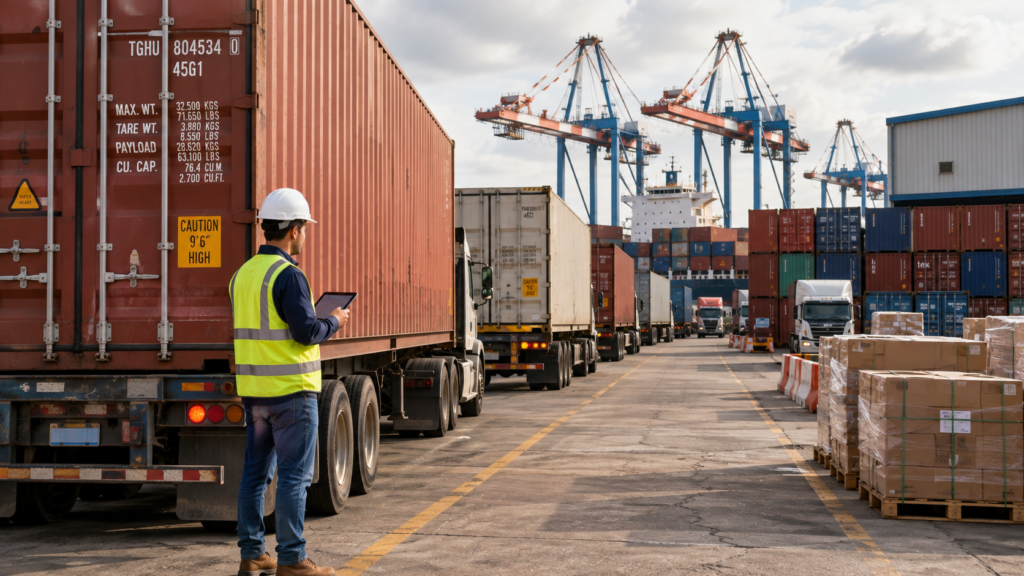
Imagine your company owns a manufacturing plant in Ohio.
What you’ll understand
- Business Insurance Risk Explorer
- Your Building Can Be Fine While Your Business Stops
- What Is Contingent Business Interruption Insurance?
The building is fine.
There is:
No fire.
Business Insurance Risk Explorer
Select the exposures that apply to your business.
This is an educational risk-mapping tool, not a coverage recommendation. Requirements and suitable limits depend on the business, contracts, jurisdiction and policy terms.
No flood.
No storm damage.
No broken machinery.
But production suddenly stops.
Why?
A specialized component you need comes from a supplier thousands of miles away.
That supplier cannot deliver.
Within days:
Production slows → inventory runs out → orders are delayed → customers leave → revenue falls.
Your property suffered:
$0 physical damage.
Your business suffers:
$500,000 in lost income.
Now comes the uncomfortable question:
Will your insurance pay?
The answer may be:
Not necessarily.
That is the supply-chain insurance problem businesses need to understand in 2026.
Traditional Business Interruption Starts With Your Property
Business interruption insurance is designed to protect income when operations are interrupted by a covered event.
But traditional coverage commonly requires:
direct physical loss or damage
to insured property caused by a covered peril.
For example:
Fire damages your factory → production stops → business income falls.
That is the classic business interruption scenario.
But modern businesses don’t operate entirely within their own walls.
They depend on:
suppliers + utilities + transportation + cloud services + ports + telecommunications + customers.
A failure anywhere along that network can interrupt operations.
Your Building Can Be Fine While Your Business Stops
Consider an electronics manufacturer.
Its factory is operational.
Its employees are available.
Its machinery works.
Its customers are placing orders.
But one semiconductor supplier shuts down.
Without that component, the manufacturer cannot complete its product.
The company may still face:
- Lost revenue
- Payroll
- Rent
- Loan payments
- Customer penalties
- Expedited shipping costs
- Alternative sourcing expenses
The absence of damage to your own property doesn’t mean the absence of financial loss.
What Is Contingent Business Interruption Insurance?
This is where Contingent Business Interruption (CBI) coverage becomes important.
CBI is designed to address certain business-income losses resulting from disruption involving third parties on which your business depends.
That can include:
Suppliers
Companies providing materials, components or services.
Customers / Receivers
Businesses that purchase or receive your products.
Marsh explains that CBI commonly protects against lost income and extra expenses when disruption to key suppliers or customers interrupts the insured company’s operations.
Simple CBI Example
Imagine your company produces furniture.
You purchase specialty wood from one major supplier.
A fire destroys the supplier’s warehouse.
The supplier cannot deliver for:
three months.
Your factory is undamaged.
But production falls dramatically.
If your CBI coverage applies to:
that supplier + that type of physical damage + resulting income loss,
the policy may potentially respond, subject to its limits and conditions.
But CBI Can Still Have a Physical-Damage Requirement
This is where businesses sometimes misunderstand their protection.
They think:
“We bought contingent business interruption insurance, so every supplier interruption is covered.”
Not necessarily.
Marsh notes that CBI is typically triggered when a key supplier or customer suffers direct physical loss or damage, and coverage depends heavily on the policy’s definitions and covered perils.
So:
Supplier factory burns down → potentially covered.
But:
Supplier stops production because of financial insolvency → potentially not covered.
Supplier cannot ship because of a trade restriction → potentially not covered.
Supplier’s computer system fails → potentially not covered under traditional property-based CBI.
The distinction matters enormously.
2026 Supply Chains Have Many Non-Physical Risks
Modern supply-chain disruption can result from:
- Cyberattack
- Port closure
- Labor strike
- Political unrest
- Trade restrictions
- Supplier insolvency
- Regulatory action
- Transportation bottleneck
- Critical infrastructure outage
- Pandemic
- Shipping disruption
None necessarily requires your building—or even your supplier’s building—to suffer traditional physical damage.
Marsh specifically identifies exclusions or limitations involving non-physical triggers such as cyber incidents, labor strikes, pandemics and insolvency as common CBI coverage gaps.
Scenario 1: Your Supplier Is Hacked
Imagine your primary parts supplier suffers ransomware.
Its factory is physically intact.
But:
ERP system offline
Orders unavailable
Production scheduling unavailable
Shipping systems unavailable
The supplier stops operations for ten days.
Your company runs out of components.
Traditional property-based CBI may not respond if the policy requires physical damage.
Cyber-related business interruption may require different insurance arrangements.
This is why businesses should coordinate:
Property + CBI + Cyber
rather than reviewing each policy independently.
Scenario 2: A Port Closes
Your goods arrive at a major port.
Then operations are interrupted.
Your containers cannot move.
Your warehouse has no damage.
Your supplier has no damage.
The cargo may even be physically intact.
But your company cannot obtain inventory.
You suffer:
$200,000 lost sales.
A traditional physical-damage trigger may not necessarily be satisfied.
Coverage depends entirely on the policy and circumstances.
Scenario 3: A Trade Restriction Blocks Your Supplier
Suppose your company relies on a specialized component from one country.
A new trade restriction prevents imports.
Nothing is damaged.
But the component becomes unavailable.
Production stops.
This is a:
business interruption without physical destruction.
Traditional property-based insurance may provide little or no protection for that scenario unless appropriate specialized coverage applies.
Scenario 4: Your Supplier Goes Bankrupt
Your only supplier of a critical component suddenly becomes insolvent.
The factory still exists.
The machinery still works.
There is no:
fire + flood + earthquake + explosion.
But shipments stop.
Marsh identifies insolvency as an example of a trigger that many traditional CBI arrangements may exclude.
This demonstrates why businesses need to understand:
cause of interruption
rather than merely:
amount of interruption.
The Tier-1 Supplier Problem
Many businesses know their direct suppliers.
These are commonly called:
Tier-1 suppliers.
For example:
Your company buys batteries from:
BatteryCo.
BatteryCo is your Tier-1 supplier.
But BatteryCo buys a critical battery-control chip from:
ChipCo.
ChipCo is effectively deeper in your supply chain.
Now ChipCo suffers a catastrophic loss.
BatteryCo cannot manufacture batteries.
BatteryCo cannot supply you.
You cannot manufacture your product.
Your loss began:
two levels away.
Does Your Insurance Cover Tier-2 Suppliers?
Maybe.
Maybe not.
Marsh says CBI commonly focuses on direct Tier-1 suppliers, although some programs can negotiate coverage or sublimits for Tier-2 suppliers.
This creates one of the biggest hidden supply-chain exposures.
You might know:
who you buy from.
But do you know:
who they depend on?
Swiss Re’s 2026 analysis highlights this visibility problem. In its review of Fortune 500 Europe corporate disclosures, 43% reported assessing physical risk to their own facilities, but only 7% publicly disclosed extending those assessments to supplier facilities, and fewer than 2% disclosed assessing broader infrastructure dependencies.
That doesn’t mean those percentages describe every company globally.
But they illustrate how quickly visibility declines beyond an organization’s own property.
The Single-Source Supplier Problem
Consider two manufacturers.
Manufacturer A
Critical component suppliers:
Supplier 1 + Supplier 2 + Supplier 3
Manufacturer B
Critical component supplier:
Supplier 1 only
Manufacturer B may have a much larger interruption exposure.
If Supplier 1 stops operating, there is no immediate alternative.
Single-source suppliers deserve special attention.
Ask:
If this supplier disappeared tomorrow, how long could we operate?
Calculate Your “Time to Pain”
Suppose you keep:
30 days of critical inventory.
Supplier disruption occurs today.
Days 1–20:
Operations continue normally.
Day 25:
Inventory becomes tight.
Day 30:
Critical component reaches zero.
Day 31:
Production stops.
Your:
Time to Pain = approximately 30 days.
Now compare that with supplier recovery time.
If the supplier needs:
six months
to rebuild,
you potentially face a substantial interruption.
Inventory Isn’t Always the Answer
Businesses sometimes respond:
“We’ll simply carry more inventory.”
That can improve resilience.
But inventory has costs.
More inventory means:
- More working capital
- More warehouse space
- Higher storage expense
- Potential obsolescence
- Additional property exposure
The solution isn’t necessarily:
maximum inventory.
It is:
appropriate inventory based on criticality and recovery time.
Just-in-Time Can Increase Interruption Exposure
Just-in-time inventory can improve efficiency.
Instead of holding:
three months of components,
a company might hold:
five days.
That reduces:
- Storage
- Inventory carrying costs
- Working capital requirements
But it also reduces the buffer against disruption.
A supplier outage that would previously have been inconvenient can quickly become a production shutdown.
Efficiency and resilience aren’t always the same thing.
Geographic Concentration Matters
Suppose you have five suppliers.
That sounds diversified.
But all five factories are located within:
50 miles of each other.
A single:
- Hurricane
- Earthquake
- Flood
- Regional power outage
could affect all five simultaneously.
True diversification means examining:
supplier count + geographic concentration + common dependencies.
Suppliers Can Share the Same Hidden Supplier
This is even more dangerous.
You buy components from:
Supplier A
and
Supplier B.
You assume:
“We’re diversified.”
But both suppliers obtain a critical microchip from:
Supplier C.
Supplier C shuts down.
Both A and B fail simultaneously.
Your apparent:
two-supplier strategy
was actually:
one hidden dependency.
Swiss Re’s research emphasizes that complex supply networks can transmit and amplify interruption losses across businesses and industries.
Infrastructure Is Part of Your Supply Chain
A supplier doesn’t operate in isolation.
It depends on:
Electricity
Water
Roads
Ports
Rail
Telecommunications
Cloud services
Fuel
Suppose your supplier’s factory is undamaged.
But the region loses electricity for:
10 days.
Production may still stop.
Or:
Factory works.
Road is destroyed.
Products cannot leave.
From your perspective:
same outcome — no components.
But from an insurance perspective, the trigger can be completely different.
Utilities Need Special Attention
Business interruption policies may offer service-interruption extensions for losses involving:
- Electricity
- Gas
- Water
- Telecommunications
- Other utilities
But conditions can apply.
Marsh notes that utility-related coverage may contain:
- Distance limitations
- Excluded perils
- Restrictions involving transmission lines
- Waiting periods
So don’t assume:
“Power outage = covered.”
Read the extension.
Waiting Periods Matter
Imagine your CBI coverage has a:
72-hour waiting period.
Supplier outage:
48 hours.
Your business loses:
$80,000.
The disruption may end before the waiting period is satisfied.
Marsh notes that CBI waiting periods commonly range from 24 to 72 hours, although actual policy terms vary.
For businesses where even a few hours of downtime can be expensive, this matters.
Sublimits Can Be Much Lower Than Your Main Property Limit
Imagine your commercial property policy has:
$20 million total limit.
You might assume:
“We have $20 million for supply-chain losses.”
Not necessarily.
CBI might have a separate:
$1 million sublimit.
A catastrophe affecting your most important supplier causes:
$4 million income loss.
The main property limit doesn’t automatically increase the CBI sublimit.
Businesses should specifically identify:
CBI limit + supplier-specific limit + catastrophe sublimit + waiting period.
Named vs. Unnamed Suppliers
Some policies may cover only:
specifically scheduled dependent properties.
For example:
Supplier A — listed
Supplier B — listed
Supplier C — not listed
If Supplier C causes your interruption, coverage could differ.
Marsh identifies narrow definitions of dependent properties and unscheduled suppliers as important potential CBI coverage gaps.
Businesses therefore need accurate supplier information.
Don’t Forget Your Customers
Supply-chain interruption isn’t only:
upstream.
It can also be:
downstream.
Imagine your company manufactures packaging.
Your largest customer represents:
35% of revenue.
A fire destroys the customer’s manufacturing plant.
They stop purchasing your packaging for six months.
Your facility is fine.
But your revenue falls substantially.
Certain CBI arrangements may address dependent customers or receivers, subject to policy wording.
What Is Non-Damage Business Interruption?
Non-Damage Business Interruption, commonly shortened to:
NDBI
refers broadly to interruption losses arising without the traditional physical-damage trigger.
Historically, such coverage has been more specialized.
Potential non-damage scenarios can include certain:
- Cyber events
- Strikes
- Civil unrest
- Government actions
- Supply-chain failures
- Other defined events
Swiss Re has discussed NDBI and specialized supply-chain insurance as approaches for certain interruption events occurring without physical property damage.
Availability, triggers, limits and exclusions vary substantially.
It is not a universal replacement for traditional BI.
Parametric Solutions Can Play a Role
Some organizations also use parametric insurance.
Instead of waiting for traditional physical-loss adjustment, payment may depend on an agreed measurable trigger.
For example:
Earthquake intensity reaches X
or
Wind speed exceeds Y.
Parametric coverage can potentially provide rapid liquidity.
But it introduces:
basis risk.
Your financial loss may not perfectly correspond to whether the specified trigger is reached.
It should therefore be viewed as one component of a broader risk-financing strategy.
Cyber and Supply Chain Are Becoming Connected
Modern supply chains depend heavily on software.
Manufacturers rely on:
- ERP systems
- Cloud platforms
- Logistics software
- Electronic ordering
- Warehouse systems
- Payment platforms
A cyberattack affecting any one of those systems can potentially stop physical goods from moving.
That creates a modern paradox:
Digital event → physical supply-chain shutdown.
Businesses should therefore examine:
Cyber BI
and
Dependent Business Interruption
within cyber policies as well as traditional property CBI.
Cloud Providers Can Be Critical Suppliers
For some businesses, the most important supplier doesn’t manufacture anything.
It provides:
computing.
Imagine your company is an online retailer.
Your website, inventory system and checkout depend on one cloud provider.
The cloud platform experiences a major outage.
Your warehouse is fine.
Your inventory is fine.
Your employees are fine.
Customers simply cannot place orders.
That is a supply-chain dependency.
Businesses increasingly need to map:
digital suppliers
alongside physical suppliers.
The 2026 Risk Environment Makes Mapping More Important
Marsh’s 2026 supply-chain outlook highlights:
- Geopolitical tensions
- Tariffs and trade policy
- Climate risk
- Cybersecurity
- Transportation disruptions
and recommends improved visibility into Tier-2 and Tier-3 suppliers, together with risk modelling and alternative risk-transfer approaches.
This is the key change.
Supply-chain risk management can no longer stop at:
“Who sends us the invoice?”
Businesses increasingly need to understand:
Who makes it?
Where is it made?
Who supplies them?
How does it reach us?
What infrastructure does the process depend on?
Build a Supply Chain Map
Start with your most important products.
For each one:
Product
↓
Critical component
↓
Tier-1 supplier
↓
Tier-2 supplier
↓
Manufacturing location
↓
Port / transport route
↓
Warehouse
↓
Your facility
This can expose dependencies you didn’t know existed.
Swiss Re specifically recommends supply-chain mapping as a way to identify risk hotspots and hidden aggregation risks.
Rank Suppliers by Business Impact
Don’t treat every supplier equally.
A company supplying office stationery probably isn’t as critical as the only manufacturer of your patented component.
Create categories.
Critical
Failure stops operations quickly.
Important
Failure creates significant disruption but alternatives exist.
Replaceable
Alternative suppliers can be activated easily.
Then concentrate risk-management resources on:
critical suppliers first.
Calculate Maximum Foreseeable Supply-Chain Loss
Ask:
What happens if our most important supplier disappears for 12 months?
Estimate:
Lost revenue
minus
saved expenses
plus
extra expenses
plus
expedited shipping
plus
alternative sourcing costs.
Suppose the result is:
$8 million.
Then compare it with your:
CBI limit: $1 million.
You have discovered a potentially important insurance gap before the claim occurs.
Alternative Suppliers Need to Be Real
A spreadsheet may say:
Backup supplier: Supplier B.
But have you verified:
- Capacity?
- Quality?
- Pricing?
- Regulatory approvals?
- Tooling?
- Shipping time?
- Contract availability?
A theoretical backup supplier isn’t necessarily a usable backup.
Consider pre-qualifying critical alternatives.
Test Your Business Continuity Plan
A plan stored in a PDF isn’t enough.
Run scenarios.
Scenario
Your largest supplier disappears tomorrow.
Ask:
Who is notified?
How much inventory remains?
Which customers are prioritized?
Can production switch?
Can another supplier help?
How quickly?
What will it cost?
Who contacts the insurer?
Marsh recommends treating BI planning and insurance review as recurring activities rather than something businesses discover during a claim.
Document Everything Before a Claim
CBI claims can be complicated.
Businesses may need to demonstrate:
- What happened
- Which supplier was affected
- Why operations were interrupted
- How long disruption lasted
- Expected revenue
- Actual revenue
- Extra expenses
- Mitigation measures
Marsh notes that CBI losses often require detailed financial records and evidence showing causation and mitigation.
Good documentation can make the claims process significantly easier.
2026 Supply Chain Insurance Checklist
Before your next renewal:
- Identify all critical Tier-1 suppliers.
- Identify important Tier-2 suppliers.
- Map critical supplier locations.
- Identify geographic concentration.
- Identify single-source components.
- Review supplier recovery times.
- Calculate inventory buffers.
- Identify transportation dependencies.
- Map critical ports.
- Review utility dependencies.
- Identify important cloud providers.
- Review cyber dependencies.
- Check your CBI coverage.
- Identify named dependent properties.
- Review Tier-2 coverage.
- Check CBI sublimits.
- Review waiting periods.
- Identify physical-damage requirements.
- Review cyber exclusions.
- Investigate appropriate non-damage solutions.
- Pre-qualify alternative suppliers.
- Test continuity plans.
- Review financial-loss estimates.
- Maintain supplier documentation.
- Repeat the review after major supply-chain changes.
Questions to Ask Your Insurance Broker
- Does our BI coverage require physical damage?
- Do we have contingent business interruption coverage?
- Which suppliers are covered?
- Must suppliers be specifically named?
- Are Tier-2 suppliers covered?
- What CBI sublimit applies?
- What waiting period applies?
- Are flood and earthquake included for dependent properties?
- Are utility failures covered?
- Are port closures covered?
- Are strikes covered?
- Is supplier insolvency covered?
- How are cyber-related supplier disruptions handled?
- Does our cyber policy include dependent business interruption?
- Are cloud-service outages addressed?
- Do we need specialized NDBI coverage?
- Could parametric insurance address particular gaps?
- How should we calculate appropriate CBI limits?
- What supplier information will underwriters require?
- What records would be needed after a claim?
Frequently Asked Questions
What is supply chain interruption insurance?
There isn’t necessarily one universal policy bearing that exact name. Businesses can use combinations of CBI, cyber, cargo, trade-credit, political-risk, specialized supply-chain or non-damage coverage depending on their exposures.
What is contingent business interruption insurance?
CBI generally addresses qualifying income loss and extra expense resulting from covered disruption involving certain suppliers, customers or other dependent properties rather than physical damage at your own location.
Does CBI require physical damage?
Traditional property-based CBI commonly does. The exact trigger depends on the policy. Specialized products may address certain non-physical events.
Does CBI cover every supplier?
No. Policies can restrict coverage to direct, named or otherwise qualifying dependent properties. Tier-2 and deeper suppliers may receive limited or no coverage unless specifically addressed.
Does business interruption insurance cover supplier bankruptcy?
Do not assume it does. Insolvency is one of the non-physical triggers that may be excluded from traditional CBI coverage.
Can a cyberattack on a supplier be covered?
Potentially under appropriate cyber or other specialized coverage, but traditional property CBI may not respond when its physical-damage requirement isn’t satisfied.
Can a port closure trigger business interruption insurance?
It depends on the cause of the closure and specific policy language. A port being unavailable does not automatically create coverage.
What is non-damage business interruption insurance?
NDBI refers to specialized approaches designed to address specified interruptions where traditional physical property damage is absent. Coverage availability and triggers vary significantly.
Why should businesses map Tier-2 suppliers?
Your direct supplier may depend on another company that provides an irreplaceable component. A failure at that deeper-tier supplier can interrupt your operations even though you have no direct relationship with it.
How much CBI insurance should a business buy?
There is no universal amount. Businesses should model potential lost income, extra expenses, supplier recovery periods and alternative-sourcing costs and compare that exposure with available limits.
Final Thoughts
The biggest supply-chain mistake businesses can make in 2026 is assuming:
“If our property isn’t damaged, our business isn’t at risk.”
Modern companies don’t operate as isolated buildings.
They operate as networks.
Your business may depend on:
a semiconductor factory in Asia
↓
a port thousands of miles away
↓
a shipping company
↓
a regional electricity grid
↓
a cloud platform
↓
a trucking company
↓
your warehouse.
Break one critical link and the entire operation can slow down.
Swiss Re’s latest analysis highlights exactly this problem: business continuity depends not only on a company’s own facilities but also on suppliers, infrastructure and logistics networks, while visibility into those deeper dependencies remains limited.
Traditional property insurance remains essential.
But in 2026:
Protecting the building is not the same as protecting the business.
A stronger strategy is:
Map dependencies → identify bottlenecks → quantify downtime → build alternatives → review insurance triggers → test the recovery plan.
Because the next major interruption may leave your building completely untouched.
Key terms in this guide
Tap a term to review the plain-English meaning while you read.
Exclusion
A policy provision that removes specified situations, causes, property, people or losses from coverage.
Claim
A request for payment or benefits under an insurance policy after an event that may be covered.
Network
The group of healthcare providers or facilities that contract with a health plan under specified payment arrangements.
Business Interruption
Coverage that may help with eligible lost income and continuing expenses after a covered event interrupts business operations.
Sublimit
A lower limit inside the policy that applies to a specific type of property, loss or benefit.
Waiting Period
A specified period that must pass before certain coverage or benefits become available.
Did the guide make sense?
Answer two quick questions. Your score stays in this browser.
Verify Current Rules
Insurance rules, benefits and product terms can change. These official resources are useful starting points for checking current requirements; they do not replace your policy documents or jurisdiction-specific advice.
Thanks — your response is saved in this browser.
Continue learning, not just scrolling
Follow a practical path from understanding the idea to comparing options and preparing for real-world decisions.
 StartWorkers’ Compensation Insurance Guide: Coverage, Benefits, Costs, and Employer ResponsibilitiesBuild the foundation →
 CompareCannabis Business Insurance: Navigating federal vs. state gaps for dispensaries in legal states.Compare your options →
 PlanGeneral Liability Insurance Guide: What It Covers, Costs and Why Businesses Need ItUnderstand the numbers →
 ActBusiness Interruption Insurance Explained: Coverage, Claims, Costs and Common GapsBe ready for a claim →
Leave a Comment
Share a helpful question or experience. Your email address will not be published.