
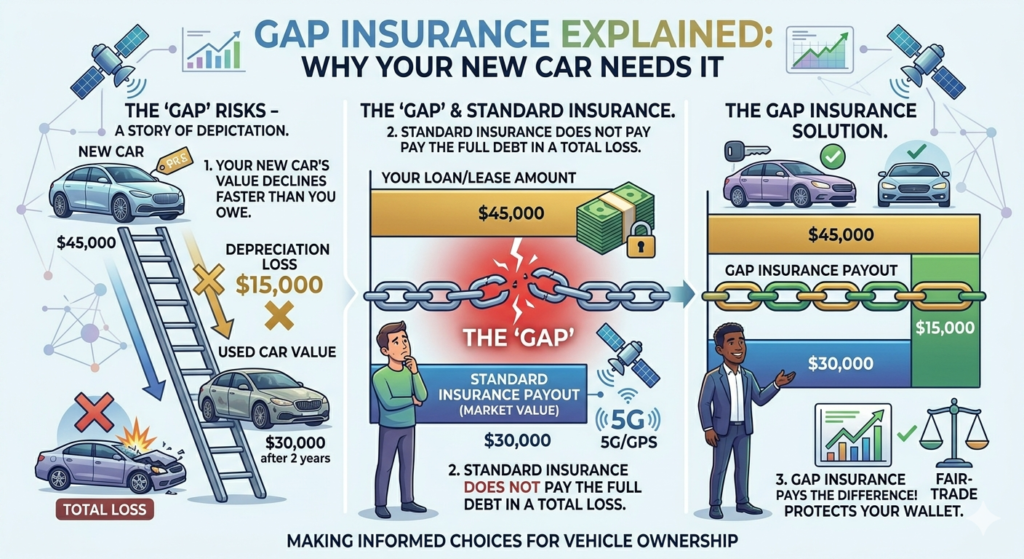
You buy a brand-new car for $40,000.
What you’ll understand
- Auto Coverage Scenario Checker
- What Is GAP Insurance?
- Why Does the “Gap” Exist?
A few months later, it’s totaled in a serious accident.
Your auto insurer determines that the car’s covered value at the time of the loss is only $34,000.
But you still owe your lender:
Auto Coverage Scenario Checker
Choose an incident to see which part of an auto policy is commonly worth reviewing.
This tool identifies common coverage areas to review. It does not determine whether a claim is covered; policy wording, deductibles, limits, exclusions and local law control.
$38,000.
Your regular auto insurance settlement may address the vehicle’s insured value, but it doesn’t automatically erase the amount you still owe on your loan.
That could leave a:
$4,000 gap.
This is exactly the financial problem that Guaranteed Asset Protection, commonly called GAP, is designed to address.
The Consumer Financial Protection Bureau (CFPB) explains that GAP is an optional product intended to cover the difference between the amount you owe on an auto loan and what the insurer pays if the vehicle is stolen or totaled.
For some new-car buyers, GAP can be valuable protection.
For others, it’s an unnecessary expense.
Let’s look at how it actually works.
What Is GAP Insurance?
GAP stands for Guaranteed Asset Protection or is commonly marketed as Guaranteed Auto Protection.
Its purpose is relatively simple.
If your financed or leased vehicle suffers a qualifying total loss and:
Loan balance > applicable insurance settlement
GAP may cover some or all of that difference, subject to the contract’s terms, limits, exclusions and deductible treatment.
The CFPB describes GAP as an optional add-on that can address the difference between a vehicle’s cash value and the remaining loan or lease balance when the vehicle is stolen or totaled.
Why Does the “Gap” Exist?
The problem comes from the difference between two things:
What Your Car Is Worth
and
What You Still Owe
Vehicles generally depreciate over time.
But your auto loan balance doesn’t necessarily decline at exactly the same rate.
During part of your loan, you might therefore owe more than the vehicle’s current value.
This is often called being:
Upside down
or
Underwater on your auto loan.
A Simple GAP Insurance Example
Suppose you finance a new SUV.
Original purchase price
$45,000
After some time, your outstanding loan balance is:
$39,000
Your SUV is totaled.
Your insurer determines the covered value is:
$34,500
For simplicity, assume the applicable insurance payment toward the vehicle is $34,500.
You still owe:
$39,000
Difference:
$4,500
Without GAP protection, you could potentially remain responsible for that $4,500 loan balance.
With qualifying GAP protection, some or all of that difference could potentially be covered according to the contract.
That’s the fundamental purpose of GAP.
Why Regular Auto Insurance May Not Pay Off Your Loan
This is one of the biggest misconceptions among new-car owners.
You may think:
“My car has full coverage, so if it’s totaled, the entire loan will be paid.”
Not necessarily.
Collision and Comprehensive coverage protect against eligible physical losses to the vehicle.
They don’t guarantee that your insurer will pay whatever balance happens to remain on your financing agreement.
The CFPB explains that standard auto insurance generally pays up to the vehicle’s value, while GAP is designed for situations where the loan balance is greater than that value.
Your loan and your vehicle’s value are separate calculations.
Why New Cars Can Be Vulnerable to a GAP
A new vehicle can lose value while the borrower still has a substantial financing balance.
A GAP can become more likely when you:
- Make a small down payment
- Make no down payment
- Choose a long loan term
- Finance taxes and fees
- Finance optional add-ons
- Pay a high purchase price relative to vehicle value
- Roll negative equity from an old vehicle into the new loan
The CFPB’s auto-finance materials have specifically associated GAP products with financing situations involving small down payments and extended loan terms.
Who Should Seriously Consider GAP Insurance?
GAP can be particularly worth investigating in several situations.
1. You Made a Small Down Payment
Suppose you buy a:
$42,000 vehicle
and put down:
$1,000.
You’re financing most of the purchase.
If the vehicle’s value declines faster than your loan balance, you could quickly become underwater.
A larger down payment reduces the amount you need to borrow and therefore may reduce your potential GAP exposure.
The CFPB notes that a larger down payment means borrowing less and may also lower your monthly payment and total financing cost.
2. You Put Nothing Down
Zero-down financing can be convenient.
But you’re beginning the loan with little equity in the vehicle.
If a total loss happens early, the difference between the insurance settlement and loan balance can potentially be significant.
This is one of the circumstances where obtaining a GAP quote deserves consideration.
3. You Have a Long Auto Loan
Auto loans lasting:
- 60 months
- 72 months
- 84 months
can keep borrowers in negative-equity territory longer, depending on the loan structure and vehicle depreciation.
Longer financing can make monthly payments appear more affordable while potentially increasing total interest costs.
The CFPB warns consumers to look beyond monthly payments and consider the total cost of the loan, because extending the term can increase the amount of interest paid.
If you select a long term, compare your projected loan balance with the likely value of the vehicle over time.
4. You Rolled Negative Equity Into the New Loan
This is particularly important.
Suppose your old vehicle is worth:
$15,000
but you owe:
$20,000.
You’re:
$5,000 underwater.
You trade it for a new car and roll that $5,000 into the new financing.
Now your new loan can begin substantially above the value of the new vehicle.
That can create a large gap immediately.
Before assuming GAP will cover all rolled-over negative equity, however, read the contract carefully.
GAP products may impose limits or exclusions on the amount they will cover.
5. You Finance Taxes, Fees and Add-Ons
Your loan may include more than the vehicle itself.
For example:
Vehicle:
$35,000
Taxes/fees:
$3,000
Extended service product:
$2,000
Other financed items:
$1,000
Amount financed:
$41,000
But that doesn’t mean your vehicle is worth $41,000.
The more non-vehicle expenses included in your financing, the greater the potential difference between the loan balance and the vehicle’s value.
Also, don’t assume every financed add-on will be included in a GAP settlement.
Read the contract.
6. You’re Leasing a Vehicle
GAP protection can also be important with leases because the lease payoff and vehicle value may diverge.
However, don’t automatically purchase separate GAP coverage.
The CFPB’s auto-finance examination materials note that many lease contracts offered by captive finance companies typically include a form of GAP waiver.
Ask:
“Is GAP already included in my lease?”
Paying for duplicate protection makes little sense.
When You May NOT Need GAP Insurance
Despite its usefulness, GAP isn’t necessary for everyone.
You may have less need for it when:
- You paid cash for the vehicle.
- You made a substantial down payment.
- Your loan balance is already below the vehicle’s value.
- Your existing loan or lease includes appropriate GAP protection.
- Your insurer provides similar protection through another endorsement.
- You can comfortably absorb any potential deficiency yourself.
The key calculation is:
Current loan payoff
versus
Current vehicle value
If your loan payoff is:
$22,000
and your vehicle is reasonably worth:
$28,000,
there may be no current negative-equity gap for GAP to address.
GAP Insurance Is Not a Replacement for Collision or Comprehensive
This distinction is critical.
GAP doesn’t function as ordinary physical-damage insurance.
It generally comes into play after a qualifying total loss where another applicable auto insurance settlement doesn’t fully satisfy the outstanding financing obligation.
You still need the underlying vehicle insurance required by your lender or lease agreement.
The CFPB notes that lenders require borrowers to maintain insurance protecting financed vehicles and may obtain force-placed insurance if required coverage lapses.
Think of the roles separately:
Collision/Comprehensive
Protects against eligible damage or loss involving the vehicle.
GAP
Addresses an eligible financing shortfall after a covered total loss.
What Does GAP Insurance Typically Cover?
Exact contracts differ.
Generally, GAP is designed to address some or all of the difference between:
The outstanding qualifying loan/lease balance
and
The applicable vehicle insurance settlement
after a total loss.
A total loss can result from situations such as:
- Major collision
- Vehicle theft where the car isn’t recovered
- Fire
- Flood
- Other covered catastrophic damage
But only if the underlying loss and GAP contract requirements are satisfied.
What GAP Usually Does NOT Cover
GAP shouldn’t be viewed as a catch-all policy for anything connected to your car loan.
Depending on the contract, exclusions or limitations may involve:
- Missed loan payments
- Late fees
- Certain finance charges
- Extended warranties
- Service contracts
- Past-due amounts
- Negative equity beyond contractual limits
- Deductibles beyond a specified allowance
- Vehicle repairs when the vehicle isn’t totaled
- Mechanical breakdown
- Reduced resale value
- Repossession
- Voluntary surrender
Contracts differ significantly.
This is why you should ask for the actual GAP contract—not rely solely on a salesperson’s description.
Does GAP Pay Your Deductible?
Maybe.
Some GAP products may cover or waive a limited amount associated with the primary insurance deductible.
Others may not.
For example:
Insurance settlement:
$29,000
Loan payoff:
$33,000
Collision deductible:
$1,000
The calculation can depend on exactly how your GAP contract defines:
- Covered balance
- Insurance proceeds
- Deductible
- Maximum benefit
Don’t assume GAP automatically reimburses your entire auto insurance deductible.
Where Can You Buy GAP Coverage?
This is another area where consumers can potentially save money.
GAP may be available through:
Your Auto Insurer
Some insurers offer GAP or loan/lease payoff coverage.
Your Dealer
Dealership finance departments frequently offer GAP during vehicle financing.
Your Lender or Credit Union
Banks and credit unions may offer GAP-related products with eligible auto loans.
The CFPB specifically advises consumers to compare GAP prices because their own auto insurer or lender may offer alternatives to dealer-provided GAP.
Dealer GAP vs. Insurance-Company GAP
Don’t assume they’re identical.
| Feature | Dealer/Lender GAP | Auto Insurer GAP |
|---|---|---|
| Purchase timing | Often at vehicle purchase | Usually with insurance policy |
| Cost structure | May be upfront/financed | Often added to premium |
| Interest cost | Possible if financed | Usually not financed into auto loan |
| Cancellation rules | Contract-specific | Policy-specific |
| Eligibility | Contract-specific | Insurer-specific |
| Coverage limit | Varies | Varies |
The better option depends on price and contract terms.
The Hidden Cost of Financing GAP
Suppose the dealership offers GAP for:
$900
and you add that $900 to your vehicle loan.
You’re no longer simply paying $900.
You’re borrowing that money.
The CFPB warns that financing GAP increases the amount borrowed and therefore increases the total interest you may pay over time.
This is why comparing a dealer’s one-time GAP price against an insurer’s annual GAP endorsement can be worthwhile.
Example: GAP Financed Into Your Loan
Imagine:
GAP price:
$1,000
You finance it as part of a long auto loan.
That $1,000 becomes part of the principal on which interest may be charged.
Your real total cost can therefore exceed:
$1,000
The longer the financing and the higher the interest rate, the more significant that difference can become.
Don’t evaluate add-ons solely by how little they increase the monthly payment.
Evaluate their total cost.
Is GAP Insurance Mandatory?
Usually, GAP is an optional product rather than a general legal requirement.
The CFPB says GAP insurance and similar auto-loan add-ons are generally optional.
If a dealer says:
“The bank won’t approve your loan unless you buy our GAP.”
ask them to show you where the financing agreement says that.
The CFPB specifically advises consumers who are told GAP is required to verify the requirement directly with the lender or identify it in the sales contract.
Do not confuse:
Lender-required physical damage insurance
with
GAP protection.
They are different products.
What Happens Without GAP?
Let’s look at a more detailed example.
You finance:
$50,000
After 12 months:
Loan balance:
$44,000
Vehicle value at total loss:
$38,000
Applicable insurance settlement:
$38,000
Remaining loan balance:
$6,000
Without applicable GAP protection, you may remain responsible for the deficiency.
Worse, you may need another vehicle.
That can leave you facing:
Old car debt + cost of replacing the car.
This is why GAP can be especially valuable early in an underwater loan.
What Happens With GAP?
Using the same simplified example:
Loan balance:
$44,000
Insurance settlement:
$38,000
Potential gap:
$6,000
If your GAP contract covers the full qualifying $6,000 difference, it may pay or waive that amount according to its terms.
You would then avoid carrying that qualifying deficiency after the vehicle is gone.
But remember:
GAP does not automatically guarantee every dollar of your loan will disappear.
Exclusions, limits and unpaid amounts can affect the final benefit.
How to Determine Whether You’re Underwater
You can perform a simple check.
Step 1: Get Your Loan Payoff Amount
Contact your lender or check your online loan account.
Don’t simply use the original loan balance.
Find the current payoff amount.
Example:
$31,500
Step 2: Estimate Your Vehicle’s Current Market Value
Use reputable vehicle valuation tools and local market comparisons.
Suppose:
$27,500
Step 3: Calculate the Difference
$31,500 − $27,500 =
$4,000
You may have approximately $4,000 of negative equity.
That doesn’t tell you exactly what an insurance settlement would be, but it can help you understand whether GAP deserves consideration.
When Should You Cancel GAP?
GAP doesn’t necessarily remain useful throughout your entire loan.
Eventually, your loan balance may fall below the vehicle’s value.
Suppose:
Vehicle value:
$24,000
Loan payoff:
$18,500
You now have approximately:
$5,500 positive equity.
A total-loss settlement based around the vehicle’s applicable insured value may already be sufficient to satisfy the loan.
At that point, GAP may provide little or no practical benefit.
Review the cancellation provisions.
Can You Get a GAP Refund?
Potentially.
The CFPB advises consumers that they may be entitled to a refund in some circumstances when an auto loan ends early because they:
- Sell the vehicle
- Refinance
- Pay off the loan early
Refund eligibility depends on the product, contract and circumstances.
This is worth checking because GAP can sometimes be prepaid for a period longer than you actually use it.
The CFPB has also taken enforcement action involving failures to properly handle GAP refunds when consumers were entitled to them.
What If You Refinance Your Car?
Don’t assume your original GAP contract automatically transfers to the refinanced loan.
Refinancing terminates the original financing arrangement and creates a new one.
Your GAP product may:
- End
- Become refundable
- Need replacement
- Have special refinancing provisions
Before refinancing, ask:
“What happens to my current GAP coverage?”
Then check whether the new loan needs separate protection.
What If You Trade In the Vehicle?
When you trade your car, GAP protection associated with the old financing may end.
If you’re entitled to an unused premium refund, request it.
Also pay close attention if your trade has negative equity.
Rolling old debt into a new vehicle loan can increase the chance that you’re underwater on the replacement vehicle from day one.
GAP Insurance vs. New Car Replacement Coverage
These are often confused.
They solve different problems.
GAP Insurance
Focuses primarily on:
Your financing shortfall.
New Car Replacement Coverage
Generally focuses on:
Replacing a qualifying totaled vehicle with a new vehicle, subject to the policy’s eligibility rules and limits.
You could potentially have one without the other.
Ask your insurer how its particular products interact.
GAP Insurance vs. Loan/Lease Payoff Coverage
Some auto insurers call their product:
Loan/Lease Payoff
rather than GAP.
These products can function similarly but may have different maximum benefits.
For example, an insurer might cap the benefit at a percentage of the vehicle’s value rather than paying an unlimited financing deficiency.
Never assume that two products with different names provide identical protection.
Read the limit.
GAP Insurance vs. Extended Warranty
These products have completely different purposes.
GAP
Helps address a qualifying loan deficiency after a total loss.
Extended Warranty / Vehicle Service Contract
Helps pay for certain mechanical repairs covered by the contract.
The CFPB identifies GAP and extended warranties as separate optional auto-financing add-ons.
Buying an extended warranty doesn’t mean you have GAP.
Buying GAP doesn’t cover ordinary mechanical failures.
GAP Insurance vs. Credit Insurance
Again, they’re different.
Credit insurance may make qualifying loan payments in circumstances such as:
- Death
- Disability
- Certain involuntary unemployment
depending on the specific product.
GAP is focused on the financing deficiency associated with a qualifying vehicle total loss.
The CFPB identifies these as separate optional financial products.
How Much GAP Coverage Do You Need?
You generally don’t choose a simple limit such as:
$5,000
or
$10,000
in the same way you choose an auto liability limit.
Instead, GAP products usually define a maximum benefit through contractual terms.
Pay attention to provisions involving:
- Maximum loan-to-value
- Maximum benefit
- Negative equity
- Deductibles
- Late payments
- Loan term
- Vehicle age
- Vehicle value
- Commercial use
- Refinancing
A cheap GAP product with restrictive limits may provide less protection than you expect.
Seven Questions to Ask Before Buying GAP
Ask the dealer, lender or insurer:
- What is the total cost?
- Is the GAP price being financed?
- What is the maximum benefit?
- Does it cover my insurance deductible?
- How is negative equity treated?
- Can I cancel it early?
- Will I receive a refund if I refinance, sell or pay off the vehicle early?
And ask for the answers in the actual contract.
Warning Signs When Buying GAP at a Dealership
Be cautious if you’re told:
“Everyone has to buy this.”
“The lender won’t approve you without it.”
“It’s only another $15 per month.”
“Don’t worry about the contract.”
The CFPB emphasizes that optional auto-loan add-ons can increase both the amount financed and the total cost of borrowing.
Focus on:
Total product price
rather than
Monthly payment increase.
Is GAP Worth It on a $60,000 New Car?
It depends.
Consider two buyers.
Buyer A
Vehicle:
$60,000
Down payment:
$20,000
Amount financed:
$40,000
Buyer A begins with significant equity.
GAP may provide limited value.
Buyer B
Vehicle:
$60,000
Down payment:
$0
Taxes and add-ons financed:
$6,000
Amount financed:
$66,000
Buyer B has much greater potential negative-equity exposure.
GAP deserves serious consideration.
Same vehicle.
Completely different risk.
Is GAP Worth It on a Used Car?
Potentially.
GAP isn’t exclusively a new-car product.
A used vehicle can also be financed for more than its current value, particularly if:
- The down payment is small.
- Negative equity is rolled into the loan.
- The loan term is long.
- Add-ons are financed.
- The purchase price is high relative to market value.
The important factor is loan-to-value, not simply whether the vehicle is new.
What Happens When Your Car Is Totaled?
A simplified process might look like this:
Step 1
You report the loss to your primary auto insurer.
Step 2
The insurer determines whether the vehicle qualifies as a total loss.
Step 3
The insurer calculates the covered vehicle settlement.
Step 4
Your lender’s financial interest is addressed.
Step 5
If a qualifying deficiency remains, you submit the required documentation to the GAP provider.
Step 6
The GAP provider determines the eligible benefit according to its contract.
GAP isn’t usually a substitute for filing the primary insurance claim.
Documents You May Need for a GAP Claim
Requirements vary, but you may be asked for:
- Primary insurer’s total-loss settlement
- Loan payoff statement
- Financing agreement
- Vehicle purchase agreement
- Insurance declarations
- Police report where applicable
- GAP contract
- Payment history
- Other loss documentation
Keep your purchase and financing documents.
They can become important years after buying the vehicle.
GAP Insurance Decision Checklist
Consider GAP more seriously if:
- You financed most of the purchase price.
- You made little or no down payment.
- Your loan lasts 60–84 months.
- You rolled negative equity into the loan.
- You financed taxes or add-ons.
- Your loan balance exceeds your vehicle’s value.
- You’re leasing and GAP isn’t already included.
You may have less need if:
- You paid cash.
- You made a substantial down payment.
- You have significant positive equity.
- Your existing policy already provides suitable protection.
- GAP is already included in your lease.
- You can comfortably absorb the potential deficiency.
Frequently Asked Questions
What does GAP insurance cover?
GAP is designed to cover some or all of the difference between the amount owed on a vehicle loan or lease and the applicable insurance settlement when the vehicle is stolen or totaled, subject to contract terms.
Is GAP insurance mandatory?
Generally, GAP is an optional auto-financing product. The CFPB says consumers generally cannot be required to buy optional GAP merely to obtain an auto loan unless the financing arrangement specifically makes it a requirement and properly discloses it.
Do I need GAP if I paid cash?
No loan means there generally isn’t a financing deficiency for GAP to cover.
Do I need GAP if I put 20% down?
Possibly not, but don’t rely on the percentage alone. Compare your actual loan payoff with your vehicle’s current value.
Does GAP pay if my car needs repairs?
Generally, GAP is designed for a qualifying total loss—not ordinary repairs.
Does GAP cover theft?
It can apply when an insured vehicle is stolen and treated as a qualifying total loss, subject to the GAP contract and primary insurance settlement.
Can I buy GAP from my auto insurer?
Some insurers offer GAP or similar loan/lease payoff protection. The CFPB recommends comparing options because insurers and lenders may offer alternatives to dealer GAP.
Is dealer GAP expensive?
Pricing varies significantly. If dealer GAP is financed into your auto loan, you’ll also pay financing costs associated with that additional borrowed amount.
Can I cancel GAP?
Many products can be cancelled, but refund and cancellation rules depend on the contract. The CFPB notes consumers may be entitled to refunds in some situations after early loan payoff, refinancing or sale.
Do leases include GAP?
Some leases already include a GAP waiver. Check your lease before purchasing another product.
When should I stop paying for GAP?
Review it once your loan balance is comfortably below your vehicle’s value and determine whether cancellation makes financial sense under your contract.
Final Thoughts
GAP insurance solves one very specific financial problem:
Your car is gone, but your car debt isn’t.
If your vehicle is totaled or stolen and your insurance settlement is lower than your outstanding financing balance, you may still owe the difference.
GAP is designed to address that deficiency.
That can make it particularly valuable when you:
Make a small down payment.
Take a long auto loan.
Finance most of the purchase.
Roll negative equity into a new loan.
Finance substantial add-ons.
But don’t automatically purchase GAP just because your car is new.
First determine whether you actually have—or are likely to develop—negative equity.
Then shop around.
The dealership isn’t necessarily your only option. The CFPB specifically notes that GAP may also be available through an auto insurer or lender and recommends comparing price and coverage before purchasing.
And if the dealer’s GAP price is added to your financing, remember that you’re potentially paying interest on the GAP product itself.
The best question isn’t:
“Is GAP insurance good?”
It’s:
“If my car were totaled tomorrow, would my insurance settlement be enough to pay off my loan?”
If the answer is no, GAP deserves serious consideration.
Key terms in this guide
Tap a term to review the plain-English meaning while you read.
Premium
The amount charged for insurance coverage, usually paid monthly, quarterly or annually.
Deductible
The amount you may need to pay toward a covered loss before the insurer pays under the policy, subject to the policy terms.
Exclusion
A policy provision that removes specified situations, causes, property, people or losses from coverage.
Endorsement
A document that changes, adds to or removes terms from the standard insurance policy.
Claim
A request for payment or benefits under an insurance policy after an event that may be covered.
Liability
Legal responsibility for injury, damage or loss suffered by another person or organization.
Did the guide make sense?
Answer two quick questions. Your score stays in this browser.
Verify Current Rules
Insurance rules, benefits and product terms can change. These official resources are useful starting points for checking current requirements; they do not replace your policy documents or jurisdiction-specific advice.
Thanks — your response is saved in this browser.
Continue learning, not just scrolling
Follow a practical path from understanding the idea to comparing options and preparing for real-world decisions.
 StartWorkers’ Compensation Insurance Guide: Coverage, Benefits, Costs, and Employer ResponsibilitiesBuild the foundation →
 CompareBehavioral Health Riders in Disability Insurance: Limits, Definitions, and What to CompareCompare your options →
 PlanMedicare Advantage 2026: A Plan-Comparison Checklist for Networks, Drugs, and CostsUnderstand the numbers →
 ActInvisible and Autoimmune Disability Claims: Building Evidence Around FunctionBe ready for a claim →
Leave a Comment
Share a helpful question or experience. Your email address will not be published.